

Databricks Buys Row Zero, Anthropic Seeks IPO Voting Control, ChatGPT Ads Expands Across Asia
By Stableton on September 30th, 2026
This week showed different ways companies are securing their futures. Databricks kept acquiring, with Row Zero as its latest buy. Anthropic's founders sought control before going public. And OpenAI pushed its ad business deeper into Asia. Let's dive in…
THIS WEEK’S BREAKING NEWS
Databricks acquires Row Zero, eyes more startups
Databricks acquired spreadsheet startup Row Zero, previously valued at roughly $40M after raising $10M in May 2025, to integrate live, scalable spreadsheets with its Genie AI agent for natural-language data queries. The deal continues Databricks' active 2026 acquisition streak, following Quotient AI, SiftD.ai, Panther, and Electric, with CEO Ali Ghodsi confirming plans for "many more" deals ahead. (1)
STABLETON NEWS
Stableton on the Road: West Coast & Texas

A lot of the technology companies we expect to matter over the next decade are still private, in AI, energy, healthcare, financial services, and elsewhere.
Our Co-Head of Investments Max Weichel and Investment Principal Konrad Gradalski are going to meet some of them this week and the next. Here’s where they’ll be:
San Francisco, California: September 28 to October 1
Los Angeles, California: October 1 to 2
Austin, Texas: October 5 to 6
We focus on growth-stage and pre-IPO companies, investing through primary rounds and direct secondaries. Reach out if you'd like to connect while they're in town.
STABLETON NEWS
Our Q2 2026 report is here
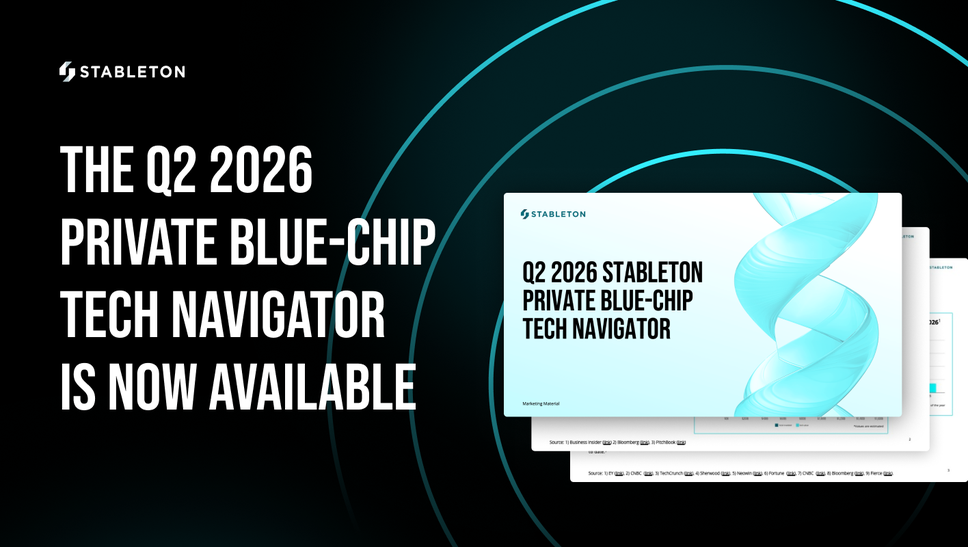
Q2 2026 was one of the biggest quarters we have seen in years.
We saw public market activity picking up significantly, with SpaceX completing the largest IPO in history and Cerebras going public in the same quarter. (2,3) Behind them, both OpenAI and Anthropic have now filed confidentially for their own listings. (4,5) Beyond the IPOs, we also saw a shift in deployment, from Figure AI’s robots entering commercial logistics to the Pentagon expanding classified AI contracts to eight top tech firms. (6,7)
Our latest Private Blue-Chip Tech Navigator breaks down what these new developments mean and where the market is moving next. Inside, we cover the quarter's largest funding rounds, secondary pricing trends, the upcoming IPO calendar, and more.
Download the full report here below.
PORTFOLIO NEWS
Latvia in talks for Anduril's long-range Barracuda missiles
Latvia is working to acquire Anduril's Barracuda cruise missiles, President Edgars Rinkēvičs confirmed after meeting founder Palmer Luckey, though pricing, version, and delivery timing remain undisclosed. The move follows Anduril's expanding European production footprint, including a U.S. Army framework for 1,000+ annual Barracuda-500Ms and Poland's PGZ assembly agreement, and would extend Latvia's strike range roughly threefold beyond its current 300km ATACMS system. (8)
Barracuda becomes first WOSA-verified mass-produced weapon
Anduril's Barracuda-M family became the first weapon in large-scale production to pass the US Air Force's WOSA open-architecture verification, following a four-day assessment by MOATEL covering 14 domains including seeker, propulsion, and guidance systems. The certification supports modular upgrades and multi-supplier component integration, with Barracuda's first customer deliveries expected in early 2027. (9)
Anthropic, OpenAI slash prices amid China competition
Anthropic launched Opus 5.5, roughly 40% cheaper than its predecessor at $4/$20 per million input/output tokens, while OpenAI released Sol and Luna, 50% cheaper than prior ChatGPT-5.6 models, intensifying price competition against low-cost Chinese rivals. Opus 5.5 is Anthropic's first release since CEO Dario Amodei's call to "pace the frontier," incorporating extensive alignment testing and third-party evaluation ahead of its planned autumn IPO. (10)
Anthropic in talks to lease 1GW from Stream
Anthropic is in early talks to lease up to 1 gigawatt of compute capacity directly from Apollo-majority-owned Stream Data Centers, part of a broader push to reduce cloud-provider reliance, following similar deals with Hut 8 and TeraWulf. The move would require at least $40B in capital investment and comes as Anthropic has entered into $531B worth of compute deals over the past 11 months, competing with OpenAI for a limited pool of data center developers. (11)
Anthropic seeks super-voting shares ahead of IPO
Anthropic's seven co-founders are seeking shareholder approval for a super-voting share structure granting them a combined 50.1% of the vote on most corporate matters, despite owning roughly 2% of the company each. The move, similar to Meta's and Snap's founder-control structures, comes as Anthropic prepares for an IPO expected to reflect its recent $1.5T secondary-market valuation, up from $965 billion in May. (12)
Anthropic launches cheaper Sonnet 5.5 model
Anthropic released Sonnet 5.5, its third model launch since CEO Dario Amodei's call to slow AI development, offering faster, cheaper performance for coding and document tasks at $2/$10 per million input/output tokens, half the price of Opus 5.5. The model includes upgraded cybersecurity safeguards previously reserved for Anthropic's most capable systems, with Haiku 5.5 still to come and availability across AWS, Google Cloud, and Microsoft Azure. (13)
Cerebras extends inference push with Gimlet Labs deal
Cerebras will supply AI chips capable of consuming roughly 100 megawatts to cloud computing startup Gimlet Labs over one to two years, providing its CS-4 systems for high-speed inference workloads on frontier models. Gimlet plans to make the hardware available in its cloud by 2027, with financial terms undisclosed, as Cerebras extends its inference-focused hardware push following its earlier OpenAI chip supply deal. (14)
Helix taps Databricks for population-scale genomic research
Helix partnered with Databricks to launch Research Workspaces, a Trusted Research Environment built natively on Databricks' platform, giving approved researchers governed access to over 550,000 GenoSphere clinicogenomic records combining genomic data with 13+ years of health records. The environment includes AI-assisted coding and population-scale analysis tools, with Helix reporting lower compute costs compared to prior platforms, extending the company's earlier Cohort Builder launch. (15)
Deel partners with Incorpify on AI orchestration layer
Business services startup Incorpify partnered with Deel to connect its global payroll, hiring, and HR infrastructure with Incorpify's AI orchestration platform covering company formation, tax, banking, and compliance. The Washington, DC-based, Plug and Play-backed startup has generated over $2M in revenue serving more than 300 business clients, aiming to unify fragmented international expansion services into one coordinated experience. (16)
ChatGPT Ads expands to seven new Asian markets
OpenAI expanded ChatGPT Ads into Indonesia, Malaysia, the Philippines, Singapore, Thailand, Vietnam, and Taiwan, bringing availability to over 60 countries total. Ads remain limited to Free and Go plan users, with Plus, Pro, and Enterprise staying ad-free, following the platform's $1B annualized revenue run rate reached in under 200 days, as OpenAI works with agency partners including dentsu, Havas Media, and WPP. (17)
OpenAI expands Daybreak access to Ukraine's government
OpenAI granted Ukraine's Ministry of Digital Transformation free access to Daybreak, its GPT-5.6 Sol-powered vulnerability detection system, to defend hospitals, power plants, and telecom networks after CERT-UA logged roughly 6,000 cyber incidents last year, up 37%. The deployment follows OpenAI's September 3 pledge of $1B in subsidized Daybreak access and extends its use by defense agencies in France, Germany, and Poland. (18)
Perplexity, AMD bring Portable Computer to local PCs
Perplexity's Portable Computer is now available on Windows PCs powered by AMD's Ryzen AI Max Series processors, including the Ryzen AI Halo developer platform, letting users run local AI tasks without consuming Perplexity Computer credits. The partnership combines AMD's shared-memory CPU-GPU architecture with Perplexity's agent tools, enabling agentic workflows that run locally while retaining the option to tap cloud-based reasoning when needed. (19)
Revolut competes with Nubank in US market entry amid hurdles
Revolut and Nubank are both entering the US banking market with conditional charters, with Nubank already launched this month while Revolut plans checking, savings, and credit products under close regulatory supervision. Revolut's $115B valuation depends partly on demonstrating US traction ahead of its planned 2028 IPO, competing against Nubank's $67B valuation and 135M-customer base as both target the $160B Latin American remittance corridor. (20)
Revolut wins approval to acquire Argentine bank
Revolut secured Central Bank of Argentina approval to acquire Banco Cetelem Argentina from BNP Paribas Personal Finance, a deal first announced in June 2025, clearing a key hurdle to launch as Revolut Bank Argentina S.A.U. More than 150,000 Argentine consumers are already on its waitlist, extending Revolut's Latin American push after its Mexico launch, which now serves over 500,000 retail customers. (21)
Revolut launches biometric checkout for UK merchants
Revolut is piloting a face-recognition checkout system in the UK, verifying customers against biometric data submitted during account signup, launching exclusively with coffee chain Kiss the Hippo ahead of a wider rollout later this year. The system carries no merchant processing fees and uses "bank grade" end-to-end encryption, arriving weeks after Revolut disclosed a separate data breach involving unauthorized access to some customer information. (22)
Rippling expands India presence with new AI Lab
Rippling launched the Rippling AI Lab at its Embassy Tech Village campus in Bengaluru, its largest engineering hub outside San Francisco, to develop core AI infrastructure and platform capabilities built on the company's Employee Graph data model. The move extends Rippling's India operations, now nearly 2,500 employees strong since 2017, with workspace expanding to 170,000 sq ft as the company hires across AI research, applied AI, and platform engineering roles. (23)
SpaceX's Starship achieves historic first orbital flight
SpaceX's Starship reached orbit for the first time on its 14th test flight, deploying 26 new Starlink V3 satellites before splashing down early, ahead of an originally planned landing off Chile's coast. The milestone supports SpaceX's Starlink business, its only profitable segment as of Q2, with the company now operating roughly 11,000 active satellites versus Eutelsat OneWeb's 650, as SpaceX preps Starship for a major NASA lunar test flight next year. (24)
OTHER NEWS
Blue Origin raises $10B, valuation hits $140B
Blue Origin completed its first external funding round in 25 years, raising roughly $10B at a $140B valuation, led by Coatue Management's $4B, with Jeff Bezos adding $2B, bringing his cumulative investment to about $32B. The company disclosed $800M in 2025 revenue, targeting $1.4B in 2026 and over $30B by 2030, as it works to return New Glenn to flight following an April thrust anomaly and a May pad explosion. (25)
China may let ByteDance and Alibaba buy Nvidia chips
China's government has signaled it may allow ByteDance and Alibaba to purchase Nvidia's new RTX Pro 5500 chips, with ByteDance reportedly weighing an order of roughly 1 million units. Nvidia targets shipping the chips in late December at about 500,000 per quarter for China, at $13,000 each, offering a potential lifeline after U.S. export controls cut Nvidia's China AI chip market share from 95% to zero. (26)
Crusoe drops $1.25B Boom Supersonic turbine deal
Crusoe abandoned its $1.25B agreement to buy 29 of Boom Supersonic's 42-megawatt Superpower turbines, ending its role as launch customer for Boom's stationary power plant business, though Crusoe says it still plans to use other turbines alongside wind, solar, and grid power. Boom, which raised $300M last year partly to fund the venture, says it will still deliver about 250MW of turbines to other sites next year, targeting 1GW by 2028. (27)
Thinking Machines signs $65M inference deal with Crusoe
Thinking Machines Lab signed a $65M annual inference deal with Crusoe to run its open models, including GLM 5.2 and 5.3, on a dedicated Nvidia HGX B200 cluster, pushing Crusoe's Managed Inference business past $100M in contracted annual recurring revenue. The deal follows a busy month for Crusoe, including its $3.9B Series F round and $13B Jane Street cloud agreement, as Thinking Machines separately explores a $6B funding round. (28)
Lovable's revenue crosses $600M as growth accelerates
Lovable's annualized revenue crossed $600M, up from $500M in June, co-founder Fabian Hedin said at the HumanX summit, with people at two-thirds of Fortune 500 companies now using the platform. Apps built on Lovable attract nearly a billion monthly views, as the company has raised over $700M across two rounds in eight months, reaching a $13.3B valuation this August. (29)
Fincadia invests $50M in Positron's $875M round
Fincadia Advisors invested $50M as part of Positron AI's $875M Series C and C-1 round, valuing the AI inference chipmaker at $5B, up from $1B at its February Series B. The financing will fund Asimov chip tapeout on TSMC's N3P process by year-end, a 2MW+ engineering data center, and production ramp-up of its next-generation Titan inference system. (30)
ZoomInfo launches native integration with Replit
ZoomInfo launched a native MCP connector inside Replit's Integrations marketplace, letting developers query verified company and contact data via natural language without custom API integration, drawing on GTM.AI's context graph of over 100M companies and 500M contacts. Replit joins Salesforce Agentforce, HubSpot Breeze, and Claude as surfaces connected through the same Model Context Protocol, with new users receiving 100 free AI credits. (31)
Shield AI's Hivemind powers UK maritime autonomy test
Shield AI and British maritime defense company Kraken Technology Group demonstrated Hivemind-enabled autonomous teaming between two K3 SCOUT uncrewed surface vessels in Portsmouth, UK, marking Shield AI's first maritime autonomy demonstration outside aviation. Hivemind coordinated ISR search, target tracking, and dynamic replanning between the vessels, as Kraken, recently valued at $1B after a $175M Series B, plans further joint trials with UK and NATO partners. (32)
Vast Data launches DataEnclave for regulated AI use
Vast Data launched DataEnclave, a confidential computing capability co-developed with Nvidia that lets banks and government agencies in Asia-Pacific run third-party AI models on data that never leaves their environment, targeting regulated sectors starting in Singapore. Over 20 launch partners have signed on, including Cohere, CrowdStrike, and cloud partners Nscale, G42, and Sharon AI, with Vast now employing about 1,200 people globally and cashflow positive. (33)
CHART OF THE WEEK
Exit activity just broke its own scale
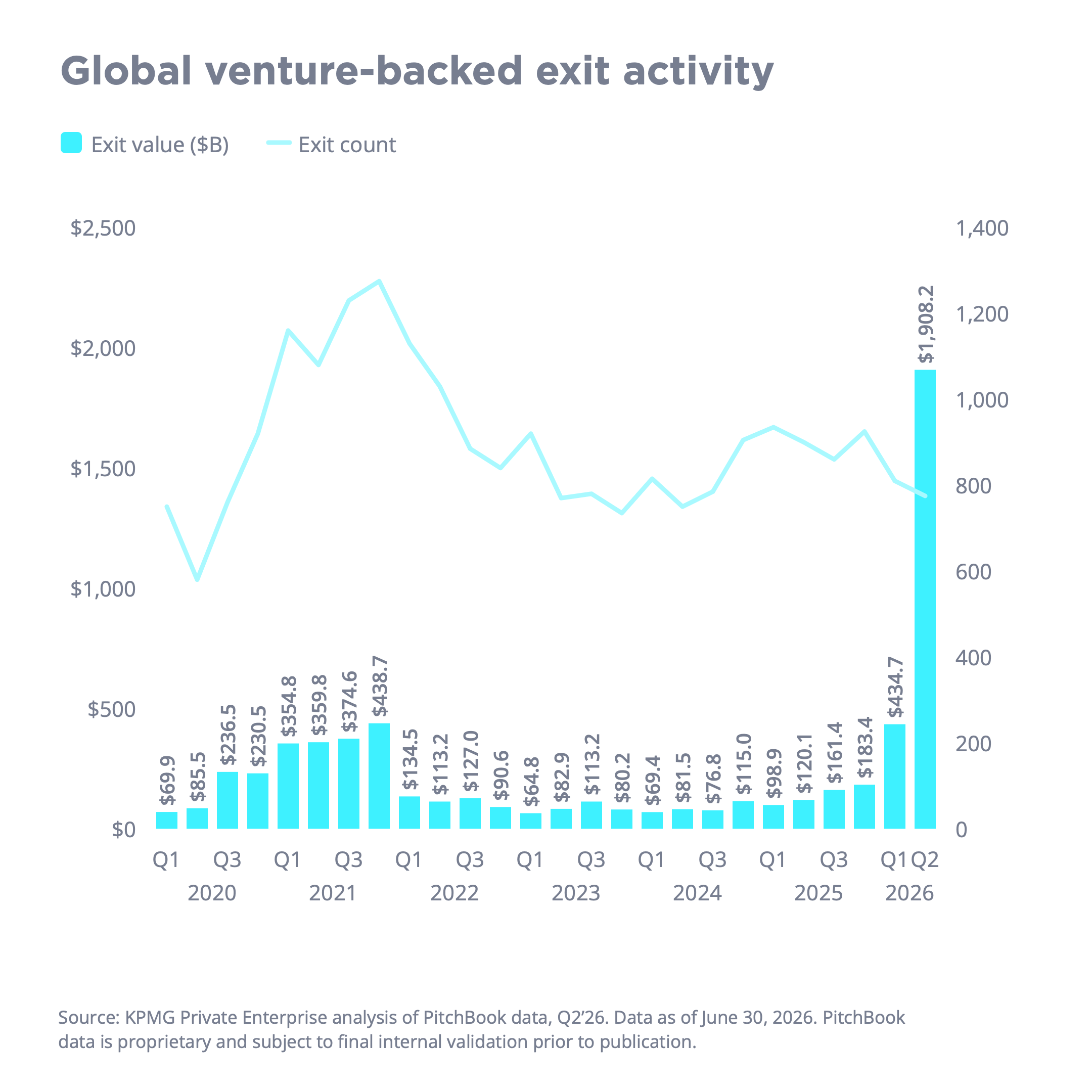
Private markets haven't seen an exit quarter like this before.
Global venture-backed exit value jumped past $1.9T in a single quarter, more than four times the previous quarter's total and far above anything else on the chart since 2020. That spike traces back to a small number of outsized AI transactions, not a broad pickup in exit activity across the market.
The same concentration shows up on the funding side. Unicorn deal value hit its own record high the same quarter, even as deal count barely moved, bigger checks going to fewer companies, on both ends of the market.
The Stableton Morningstar PitchBook Unicorn 20 strategy gives investors direct exposure to the private blue-chip technology leaders sitting at the center of this concentration, where both funding and exit activity are increasingly concentrated.
THE UNTOLD UNICORN STORY
Epic Games: Basement business turned gaming empire
 Epic Games CEO Tim Sweeney. (34)
In 1989, Tim Sweeney was a college freshman who hated the text editors that came with his programming tools, so he started building his own. Then he turned the cursor into a smiley face. Then he added walls, enemies, bullets, and puzzles. By 1991, that side project had become ZZT, a shareware game he sold for $100 a day out of his parents' basement, with his father fulfilling mail orders. ZZT shipped with something radical: a free built-in editor that let anyone create their own games, a philosophy that would later define the Unreal Engine. (35)
Sweeney dropped out of college one credit shy of a degree to go all-in on games, renaming his one-man operation "Epic MegaGames" because it sounded more impressive. Three decades later, Fortnite has over 650 million registered accounts, and the Unreal Engine powers everything from blockbuster games to The Mandalorian's virtual sets. (36)
Fun Fact: When Sweeney renamed his company to "Epic MegaGames" in 1992, he later admitted it was "kind of a scam to make it look like we were a big company." In reality, he was the only employee, working out of his parents' house. When Epic finally became a real big company, they dropped the "Mega" in 1999. (37)
Did you know? Epic Games is one of the 20 companies in our Stableton Morningstar PitchBook Unicorn 20 strategy, a systematic, index approach that aims to outperform public benchmarks with low-cost fees, and without a performance fee. Click below for more information.
SOURCES
1 - TechCrunch, 2 - NPR, 3 - CNBC, 4 - The Guardian, 5 - Bloomberg, 6 - Figure AI, 7 - The Guardian, 8 - Defence Blog, 9 - The Defense Post, 10 - Financial Times, 11 - The Information, 12 - TechCrunch, 13 - CNBC, 14 - Reuters, 15 - PR Newswire, 16 - Fintech Finance News, 17 - OpenAI, 18 - BigGo Finance, 19 - CNBC, 20 - Financial Times, 21 - Revolut, 22 - Bloomberg, 23 - Business Wire, 24 - CNBC, 25 - BigGo Finance, 26 - The Information, 27 - TechCrunch, 28 - TNW, 29 - TechCrunch, 30 - Business Wire, 31 - Business Wire, 32 - ShieldAI, 33 - Computer Weekly, 34 - The Information, 35 - MatthewBall.Co, 36 - Yahoo Finance, 37 - Game Developer

Every Wednesday, the Navigator delivers a digest of news from our portfolio holdings and key trends shaping private tech investing. Subscribe to receive it directly in your inbox.

