




Musk Builds Chip Stack Across Tesla and SpaceX, Revolut Hits £1.7B Profit, Kraken Pauses IPO
By Stableton on March 25th, 2026
Build, scale, or wait. Musk is building a chip stack across Tesla and SpaceX, Revolut is scaling into banking with record profits, and Kraken is pausing its IPO as market windows tighten. Let’s dive in…
THIS WEEK’S BREAKING NEWS
Musk unifies Tesla and SpaceX around chip manufacturing
Elon Musk unveiled plans for a joint chip manufacturing initiative across Tesla and SpaceX, aiming to vertically integrate semiconductor production for AI, robotics, and space systems. The proposed “Terafab” facilities would produce specialized chips for vehicles, humanoid robots, and space-based computing, addressing supply constraints and enabling large-scale AI infrastructure ambition. (1)
PORTFOLIO NEWS
Anduril’s new Ohio plant signals defense tech pivot
Anduril is set to launch production of its Fury autonomous combat drone at its new $1B Arsenal-1 facility in Ohio, targeting over 4,000 jobs over the next decade. Designed for the U.S. Air Force’s Collaborative Combat Aircraft program, Fury reflects a manufacturing-first approach using commercial components to accelerate scale and reduce cost. Additional systems, including Roadrunner and Barracuda, will also be produced. (2)
Pentagon labels Anthropic risk, Silicon Valley pushes back
The Pentagon’s designation of Anthropic as a “supply chain risk” has fractured Silicon Valley’s alignment with the Trump administration, triggering coordinated pushback from Microsoft and industry groups representing Apple, Meta, OpenAI, Amazon, and Google. Despite political pressure, Anthropic’s annualized revenue surged from $9B to $19B, highlighting strong market support and raising broader concerns over government intervention in AI commercialization and procurement frameworks. (3)
Applied Intuition becomes NVIDIA-recommended ADAS software provider
Applied Intuition partnered with NVIDIA to accelerate the deployment of L2+ driver assistance systems, becoming a recommended software provider for OEMs building on NVIDIA DRIVE platforms. Its production-ready ADAS stack, optimized for DRIVE AGX Orin and Thor, integrates simulation, data tooling, and AI models to reduce integration risk and speed time-to-market for scalable, software-defined vehicle architectures. (4)
Applied Intuition deploys AI data engine for US Navy
Applied Intuition launched DECK, the US Navy’s AI data engine, enabling ships to collect real-time sensor data, deliver actionable insights, and update software over the air with minimal input. Designed as a modular, scalable system, DECK addresses legacy data limitations and supports a shift toward software-defined fleets, reinforcing the role of private-sector partnerships in accelerating AI deployment in defense. (5)
Cursor’s Composer 2 built on external AI model
Cursor admitted its new Composer 2 coding model was initially built on Moonshot AI’s open-source Kimi K2.5, after users uncovered references in the code. The company clarified that roughly 25% of compute came from the base model, with the majority driven by its own training. The disclosure highlights growing reliance on open-source foundations and raises transparency concerns in frontier AI model development. (6)
Databricks and Accenture expand to unify enterprise data
Accenture and Databricks expanded their partnership to accelerate enterprise AI adoption, launching a dedicated business group supported by 25,000+ Databricks-trained professionals. The initiative focuses on deploying Databricks as a unified data and AI platform, enabling clients like Albertsons and BASF to build agent-ready databases and scale applications, addressing fragmentation and moving AI from experimentation into production environments. (7)
Kraken pauses IPO despite multi-asset expansion due to volatile market conditions
Kraken has paused its planned multibillion-dollar IPO despite confidentially filing in November 2025 and targeting a Q1 2026 listing. The exchange is reassessing timing amid market conditions, while continuing to diversify beyond crypto into equities with commission-free trading. The delay highlights ongoing volatility in public market windows for crypto-native platforms despite strategic expansion. (8)
OpenAI doubles workforce to win enterprise AI market
OpenAI plans to nearly double headcount to ~8,000 by end-2026, hiring across engineering, product, and enterprise sales to counter Anthropic’s momentum with business customers. Despite ~900M users, most remain unpaid, pushing OpenAI toward enterprise monetization, where revenue share is expected to rise from ~40% to 50%, amid intensifying competition and rising cost pressures. (9)
OpenAI unifies ChatGPT, browser, and Codex into super app
OpenAI plans to unify its ChatGPT app, browser, and Codex into a single desktop “super app,” led by Fidji Simo. The move aims to reduce product fragmentation and focus on high-productivity use cases as competition with Google and Anthropic intensifies, aligning product strategy ahead of a potential IPO. (10)
Court allows Perplexity agents on Amazon during appeal
Perplexity AI won a temporary reprieve as a U.S. appeals court paused a ruling blocking its AI shopping agents from accessing Amazon. The case centers on allegations of unauthorized data access and automated activity. The decision allows continued operation pending appeal, highlighting growing legal tension around agentic AI interacting with closed platforms. (11)
Perplexity launches free AI browser on iPhone
Perplexity AI launched its Comet AI browser as a free iPhone app, expanding from a previously $200/month PC product. The browser combines chat-based interaction with task execution, including research and shopping, but faces iOS limitations like no extensions. The shift to free distribution highlights a data-driven monetization model, with user data leveraged for ad targeting. (12)
Perplexity integrates real patient data into AI search
Perplexity AI partnered with b.well Connected Health to integrate personalized medical data into AI search, enabling users to connect records from a network spanning 2.4M providers. The collaboration shifts AI health responses from generic to patient-specific insights, while emphasizing consent-based access and privacy, positioning AI search closer to clinical-grade decision support. (13)
Revolut hits £1.7B profit as banking ambitions grow
Revolut reported record £1.7B profit on £4.5B revenue, driven by 68.3M users and strong growth in card fees (+45% to £1B), subscriptions (+67% to £708M), and interest income (+23%). Securing a UK banking license enables lending expansion and positions Revolut to scale into core banking markets, intensifying competition with incumbents. (14)
SpaceX pushes heavy-lift frontier with Starship V3 ahead of April launch
SpaceX conducted the first static fire test of its next-generation Starship V3 booster, igniting 10 engines ahead of a planned April test flight. The upgraded system increases payload capacity to over 100 tons to low Earth orbit, nearly tripling V2 capability, and introduces new launch infrastructure, signaling continued progress toward scalable heavy-lift missions for lunar and Mars programs. (15)
Stripe and Paradigm enable AI agents to transact autonomously
Stripe and Paradigm launched Tempo and the Machine Payments Protocol (MPP), enabling AI agents to transact autonomously across services. Backed by Visa, the standard supports cards, stablecoins, and bitcoin, targeting high-frequency, low-value transactions. With 100+ integrations and partners like OpenAI, the initiative positions agent-driven commerce as a multi-trillion-dollar market. (16)
OTHER NEWS
ByteDance divests Moonton in shift toward AI strategy
ByteDance agreed to sell gaming unit Moonton to Savvy Games Group for ~$6B, up from its $4B acquisition in 2021, as it pivots capital toward generative AI. Backed by Saudi Arabia’s sovereign wealth strategy, the deal strengthens Savvy’s gaming footprint while signaling ByteDance’s exit from underperforming gaming bets to refocus on AI competition. (17)
Shield AI and Mitsubishi advance UAV autonomy with Hivemind
Shield AI and Mitsubishi Heavy Industries demonstrated autonomous UAV operations in Japan using Hivemind software, enabling drones to coordinate, track targets, and execute maneuvers via reinforcement learning without human input. The program compressed development from concept to flight in under a month, highlighting scalable deployment of mission autonomy systems. (18)
NVIDIA targets China with Groq-powered AI chips
NVIDIA is preparing Groq-based AI chips for the Chinese market following a $17B licensing deal with Groq, targeting the fast-growing inference segment. While restricted from selling its latest chips, Nvidia is adapting architectures to maintain access, as competition from Chinese players intensifies and inference demand drives a projected $1T AI chip market by 2027. (19)
Mistral targets enterprise with a custom enterprise AI stack
Mistral AI introduced Forge at NVIDIA GTC, enabling enterprises to build custom AI models from scratch using proprietary data rather than relying on fine-tuning third-party systems. Positioned as a “build-your-own AI” stack, Forge emphasizes privacy, control, and on-prem deployment, targeting organizations seeking sovereignty over data and model behavior in enterprise AI adoption. (20)
VAST Data turns NVIDIA blueprints into production AI pipelines
VAST Data launched Foundation Stacks, extending NVIDIA AI Blueprints into production-ready pipelines running on its AI Operating System. The solution unifies data, compute, and orchestration layers, enabling enterprises to deploy scalable AI applications without complex integration, accelerating the shift from prototype to production across cloud and on-prem environments. (21)
CHART OF THE WEEK
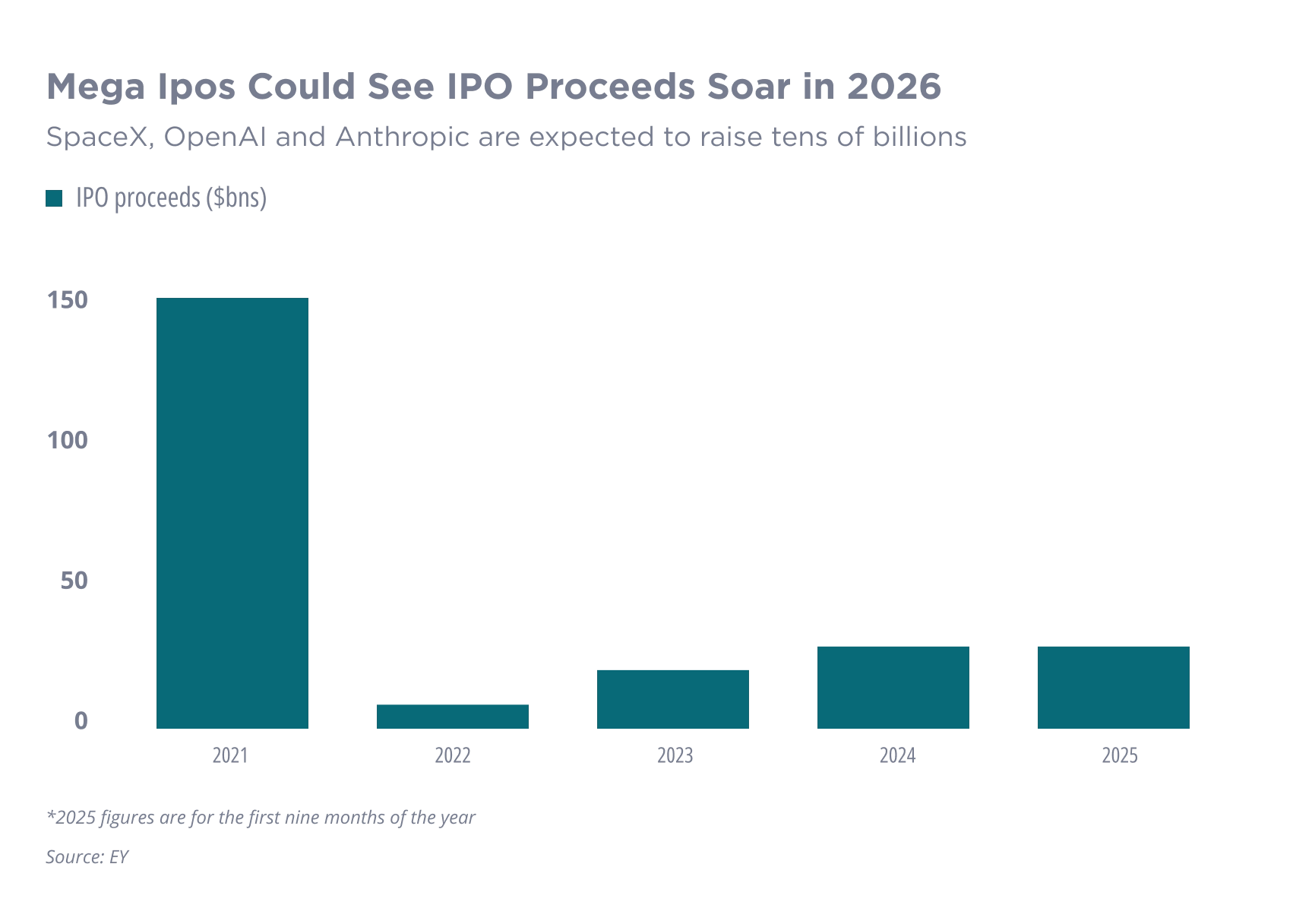
US IPO proceeds remain well below the 2021 peak, but the recent stabilization signals that public markets are rebuilding capacity rather than returning to excess. The sharp contraction after 2021 forced a reset in valuation expectations, deal quality, and investor selectivity. What is emerging now is a more deliberate reopening, where capital is reserved for companies with scale, clear economics, and strategic relevance. This points to a cycle defined less by volume and more by concentration.
The next step change is likely to come from a small group of frontier technology leaders. Expected listings from companies such as SpaceX, OpenAI, and Anthropic could inject unprecedented liquidity into public markets and reset benchmarks across sectors. Until that transition occurs, the most meaningful growth continues to compound privately. The Stableton Morningstar PitchBook Unicorn 20 strategy is focused on the companies shaping the next generation of public market leadership rather than waiting for it to arrive.
THE UNTOLD UNICORN STORY
Revolut: Born from a bank collapse
 Revolut CEO Nik Storonsky (R) with co-founder Vlad Yatsenko (L). (22)
Revolut was born out of financial disaster. In 2008, Nik Storonsky was working as a derivatives trader at Lehman Brothers when the bank collapsed, wiping out around £500,000 of his savings overnight (23). The experience convinced him that traditional banking was broken. In 2015, he teamed up with Vlad Yatsenko, a Ukrainian software engineer he met in London, and launched Revolut out of a Canary Wharf incubator with a simple pitch: stop charging people outrageous fees to spend their own money abroad (24). A decade later, Revolut has grown into Europe's most valuable private company, worth $75B, and in March 2026 finally secured its full UK banking license after a four-year regulatory battle (25).
Fun Fact: Yatsenko learned to code on paper. Growing up in post-Soviet Ukraine with limited computer access, he wrote out programs by hand before ever testing them on a machine, and took a job as a university computer lab administrator just to get internet access. (26)
Did you know? Revolut is one of the 20 companies in our Stableton Morningstar PitchBook Unicorn 20 strategy, a systematic, index approach that aims to outperform public benchmarks with low-cost fees, and without a performance fee. Click below for more information.
SOURCES
1 - TechCrunch, 2 - Defense News, 3 - Financial Times, 4 - PR Newswire, 5 - The Defense Post, 6 - Tech Crunch, 7 - Accenture, 8 - Kraken, 9 - Financial Times, 10 - CNBC, 11 - Reuters, 12 - Perplexity, 13 - PR Newswire, 14 - Financial Times, 15 - Space, 16 - Forbes, 17 - Bloomberg, 18 - Next Gen Defense, 19 - Reuters, 20 - Tech Crunch, 21 - Financial IT, 22 - Euromoney, 23 - World Finance, 24 - Contrary Research, 25 - CNBC, 26 - Techsylvania



Every Wednesday, the Navigator delivers a digest of news from our portfolio holdings and key trends shaping private tech investing. Subscribe to receive it directly in your inbox.


