




Ripple Buyback Signals $50B Valuation, Anduril Secures $20B Army Deal, Cursor Eyes 2x Valuation Jump
By Stableton on March 18th, 2026
Capital, contracts, and code are scaling fast. Ripple moves toward a $50B valuation through a buyback, Anduril locks in a $20B defense deal, and Cursor approaches a 2x valuation jump amid the AI coding boom. Let’s dive in…
THIS WEEK’S BREAKING NEWS
Share buyback signals $50B valuation for Ripple
Ripple launched a share buyback of up to $750M, implying a $50B valuation, as it seeks to provide liquidity to employees and investors amid a downturn in crypto markets. The move follows a $500M raise at a $40B valuation and continued expansion through acquisitions, including a $1.25B deal for Hidden Road. The tender offer runs through April. (1)
MARKET UPDATE
Global startup IPO pipeline faces volatile market test
Volatile markets are complicating IPO plans for venture-backed startups as falling software stocks, geopolitical tensions, and potential mega-listings from SpaceX, OpenAI, and Anthropic threaten to absorb investor demand. Still, several companies are advancing preparations: Cerebras targets an April listing, Quantinuum eyes June, while Hudl and Entrata are working with major banks. Others, including Discord and Motive, have delayed plans amid weak public comps and limited institutional appetite for new listings. (2)
STABLETON MORNINGSTAR PITCHBOOK UNICORN 20 STRATEGY

The Stableton Morningstar PitchBook Unicorn 20 strategy is the world’s first passive, systematic, and semi-liquid approach to investing in the Top 20 privately held tech companies before they go public.
This strategy offers a straightforward and cost-effective way to gain exposure to leading private technology companies within a single portfolio. With no performance fees and enhanced liquidity, it offers a unique alternative to traditional private market investments.
PORTFOLIO NEWS
US Army signs $20B software-centric defense contract with Anduril
The U.S. Army signed a 10-year enterprise contract with Anduril worth up to $20B, consolidating more than 120 separate procurement actions into a single agreement covering hardware, software, infrastructure, and services. The contract begins with a five-year base period and optional five-year extension. The move reflects the Pentagon’s shift toward faster software-driven defense capabilities as Anduril, reportedly generating about $2B in revenue, pursues funding at a $60B valuation. (3)
Anduril expands defense stack with missile tracking acquisition
Anduril acquired missile-tracking and intelligence firm ExoAnalytic Solutions to expand into space-based defense capabilities, integrating its global telescope network and missile-tracking data into Anduril’s ground and satellite systems. The move aligns with U.S. plans for a $175B missile defense architecture known as the “Golden Dome.” Founded in 2017, Anduril is also scaling space capabilities while reportedly seeking funding after its last $2.5B raise at a $30.5B valuation. (4)
Microsoft backs Anthropic in Pentagon AI dispute
Microsoft backed Anthropic’s lawsuit against the Pentagon after the defense department labeled the AI company a supply chain risk following failed negotiations over military deployment of its models. Anthropic rejected a contract that could enable lethal autonomous weapons or domestic surveillance. Microsoft warned the designation could harm the U.S. AI ecosystem and military capabilities. The dispute comes as the $380B startup deepens ties with Microsoft through a $30B cloud partnership. (5)
Anthropic expands Asia-Pacific footprint with Sydney office
Anthropic will open a Sydney office, expanding its Asia-Pacific presence to four locations alongside Tokyo, Bengaluru, and Seoul. The move targets growing enterprise demand across Australia and New Zealand, where Claude ranks 4th and 8th globally in usage relative to population. Anthropic plans to support enterprise, startup, and research customers while exploring local compute infrastructure to meet data residency requirements. (6)
Private equity taps Anthropic for portfolio-wide AI deployment
Anthropic is discussing an AI-focused joint venture with private equity firms, including Blackstone and Hellman & Friedman, to deploy its technology across portfolio companies. The proposed venture would provide Palantir-style AI integration services for PE-backed firms. Talks continue despite Anthropic’s dispute with the Pentagon. Meanwhile, the company’s annualized revenue reached $19B, up from $9B at the end of last year. (7)
Canva unlocks editable AI content with Magic Layers
Canva launched Magic Layers, a new AI capability that converts static images into fully editable, structured designs by separating elements, preserving layout relationships, and restoring live text. Built on Canva’s proprietary Design Model, which has generated hundreds of millions of assets, the feature addresses limitations of AI-generated content by enabling iterative editing without re-prompting. Magic Layers is rolling out in public beta across key markets. (8)
Cursor targets $50B valuation amid AI coding boom
Cursor is in talks to raise funding at a valuation of about $50B, nearly doubling from its $29.3B valuation following a $2.3B round in November. The AI coding startup, launched in 2023, has surpassed $2B in annualized revenue as demand for developer-focused AI tools accelerates. Backed by major investors including a16z, Coatue, Google, and Nvidia, Cursor is emerging as a key competitor to Anthropic and OpenAI in enterprise coding. (9)
Elon Musk hires Cursor leaders to boost coding push
Elon Musk is hiring senior Cursor executives Andrew Milich and Jason Ginsberg to strengthen its coding capabilities as Elon Musk acknowledges the company is behind competitors. The hires follow significant leadership turnover, including four co-founder departures. Cursor is also a competitive benchmark as xAI aims to catch up by mid-2026. (10)
Databricks brings agentic engineering to enterprise data teams via Genie Code
Databricks launched Genie Code, an autonomous AI agent designed to execute end-to-end data workflows, including pipeline building, debugging, and production maintenance. The system more than doubled success rates on real-world data tasks from 32.1% to 77.1%. Integrated with Unity Catalog for governance, Genie Code enables agentic data work. (11)
Databricks strengthens agent evaluation with Quotient acquisition
Databricks acquired Quotient AI to enhance evaluation and reinforcement learning capabilities for enterprise AI agents. Quotient enables monitoring of agent behavior, detection of failures such as hallucinations, and continuous performance improvement through structured feedback loops. The integration strengthens Databricks’ Genie, Genie Code, and Agent Bricks platforms, addressing a key bottleneck as enterprises scale AI agents from pilot to production environments. (12)
Epic adjusts in-game pricing as gaming costs continue rising
Epic Games will increase Fortnite’s V-Bucks pricing from March 19, reducing currency received per purchase while lowering battle pass costs from 1,000 to 800 V-Bucks. The move reflects rising operating costs despite Fortnite generating billions annually. Price changes include an $8.99 pack dropping from 1,000 to 800 V-Bucks. The decision has triggered user backlash amid broader industry-wide price increases driven by inflation and development costs. (13)
Nasdaq partners with Kraken to launch tokenized stocks
Nasdaq is partnering with Kraken to develop tokenized stock trading, targeting a 2027 launch that enables 24/7 trading with full governance rights, including proxy voting and dividends. The model uses one-to-one tokenization with the same Cusip for interoperability and settlement via existing infrastructure. The initiative expands Nasdaq’s earlier SEC proposal and reflects accelerating institutional adoption of tokenization across exchanges and asset managers. (14)
Kraken launches agent-native CLI for crypto trading
Kraken launched an open-source CLI designed for AI agents, enabling direct execution of crypto trading functions across 134 commands, including spot, futures, and staking. Built as a zero-dependency Rust binary with native Model Context Protocol support, it removes API complexity and enables agent-native trading workflows. The tool includes a local paper trading engine, positioning Kraken at the forefront of agent-driven financial infrastructure. (15)
OpenAI brings Sora video generation into ChatGPT
OpenAI plans to integrate its Sora video generation capabilities into ChatGPT to boost engagement and user growth, as weekly active users approach 920 million. The move follows declining traction of the standalone Sora app and increasing competition from Google’s Gemini. While integration could drive usage, it is expected to significantly increase inference costs, with OpenAI projecting over $225B in spending through 2030. (16)
Musk’s OpenAI lawsuit faces skepticism ahead of trial
A U.S. judge questioned the credibility of Elon Musk’s $134B damages claim against OpenAI and Microsoft, stating the figures appeared to be “numbers out of the air,” but allowed the testimony to proceed to trial. The lawsuit centers on allegations that OpenAI abandoned its non-profit structure. The April trial could expose OpenAI to $109B in damages and Microsoft to $25B if the jury accepts the claims. (17)
Perplexity launches local AI agent for enterprise workflows
Perplexity introduced Personal Computer, an AI agent that turns a spare Mac into a locally run, always-on system with full access to files and applications. Positioned as a secure, professional-grade digital proxy, it includes audit trails, approval controls, and a kill switch. The product targets enterprise workflows such as drafting emails and analyzing data, reinforcing Perplexity’s shift toward agent-based productivity tools. (18)
Perplexity integrates Plaid to power AI-driven finance
Perplexity expanded its AI agent platform with enhanced financial capabilities by integrating Plaid data into Perplexity Computer. The system now accesses over 40 live data sources, including SEC filings, FactSet, and S&P Global, enabling personalized, real-time portfolio analysis. Users can connect brokerage accounts via Plaid, reflecting a shift toward intelligent finance. (19)
Ramp aims non-employee travel with Juno acquisition
Ramp acquired guest travel platform Juno to expand beyond employee travel into managing complex, high-volume logistics for candidates, contractors, and partners. The deal strengthens Ramp’s financial operations platform by integrating non-employee travel workflows, historically handled outside core systems. Juno brings scalable capabilities and prior founder experience, supporting Ramp’s push toward an enterprise-grade travel solution. (20)
Billhop deal opens European market access for Ramp
Ramp acquired Stockholm-based Billhop to enter Europe and the UK, leveraging its regulatory licenses to offer corporate cards, vendor payments, and financial operations tools without requiring a U.S. entity. The move grants passporting rights across the EEA and FCA authorization in the UK. Ramp, valued at $32B with over 50,000 customers, plans local expansion as competition with Brex and incumbents intensifies. (21)
UK banking license approval heralds Revolut's next growth phase
Revolut received full UK banking approval from the Prudential Regulation Authority after a five-year process, enabling it to offer deposit accounts and expand into lending and mortgages. The fintech, valued at $75B with 13M UK customers, had faced delays due to accounting and regulatory concerns. The license marks a key step in scaling its domestic offering and broader global expansion plans. (22)
Australian license unlocks Ripple’s Asia-Pacific expansion
Ripple plans to acquire BC Payments to obtain an Australian Financial Services License, enabling expansion of its Ripple Payments platform across Asia-Pacific. The move strengthens its regulatory footprint, adding to over 75 global licenses, including a recent EU EMI license. The acquisition supports institutional adoption of integrated crypto and traditional payment infrastructure, positioning Australia as a key regional hub. (23)
Stripe and Wizard advance AI-driven retail infrastructure
Wizard partnered with Stripe to accelerate adoption of the Agentic Commerce Protocol (ACP), enabling retailers to integrate with AI agents through a standardized framework for product discovery and checkout. ACP supports secure payments via shared tokens and reduces integration complexity. The collaboration builds on Stripe’s work with OpenAI and Microsoft, positioning agent-driven commerce as a new distribution layer for merchants. (24)
xAI and Tesla unveil Macrohard for software disruption
Elon Musk unveiled “Macrohard,” a joint Tesla–xAI project combining Grok with a Tesla-built agent to automate software workflows by interpreting real-time user inputs. The system aims to emulate full software company functions, intensifying concerns around agent-driven disruption. The initiative follows Tesla’s $2B investment in xAI and its integration with SpaceX, highlighting growing vertical integration across AI, hardware, and infrastructure. (25)
xAI secures permit for expanded AI datacenter power
xAI received approval to operate 41 methane gas turbines at its “Colossus 2” datacenter in Mississippi, nearly doubling capacity to support its AI supercomputing infrastructure. The decision, made despite significant public opposition, highlights the growing energy demands of AI systems. Critics argue the expansion could worsen pollution, underscoring rising regulatory and environmental tensions tied to large-scale AI infrastructure deployment. (26)
OTHER NEWS
ByteDance taps Nvidia Blackwell chips via global buildout
ByteDance is securing access to Nvidia’s Blackwell AI chips by deploying infrastructure outside China, including plans for around 36,000 B200 chips in Malaysia through partners such as Aolani Cloud. The setup, potentially exceeding $2.5B in hardware, reflects efforts to bypass export restrictions and scale global AI capabilities as the company expands its AI product ecosystem and international revenue base. (27)
ByteDance delays Seedance global launch amid legal backlash
ByteDance has paused the global rollout of its Seedance 2.0 video model following legal backlash from major studios over intellectual property concerns. The model, launched in China in February, gained viral traction but triggered cease-and-desist actions from companies including Disney. The delay reflects rising legal scrutiny around AI-generated content as ByteDance works to implement stronger IP safeguards. (28)
Amazon-Cerebras deal targets faster and cheaper AI inference
Amazon and Cerebras partnered to deploy Cerebras AI chips within AWS data centers, combining them with Amazon’s Trainium3 chips to optimize AI inference workloads. The architecture splits tasks between prefill and decode stages, aiming to improve speed and cost efficiency. Valued at $23.1B, Cerebras strengthens its position against Nvidia, with the joint service expected to launch in the second half of the year. (29)
Oracle adds Cerebras alongside Nvidia and AMD
Oracle signaled it is incorporating Cerebras AI chips into its cloud infrastructure alongside Nvidia and AMD, marking a potential diversification of Cerebras’ customer base ahead of a planned IPO. The move could reduce reliance on a single major client that previously accounted for 87% of revenue. It follows a $10B OpenAI commitment and highlights intensifying competition in AI inference performance and cost optimization. (30)
Lambda and Nvidia scale AI infrastructure with Blackwell
Lambda expanded its collaboration with Nvidia at GTC 2026, becoming a launch partner for the Vera CPU platform and deploying AI infrastructure featuring over 10,000 Blackwell Ultra GPUs with advanced CPO networking. The company also introduced bare metal instances for high-performance AI workloads. The initiative targets scaling “AI factories,” emphasizing network architecture and system-level optimization for next-generation agentic AI systems. (31)
Truist-Plaid partnership advances secure data-driven banking
Truist and Plaid expanded their open banking partnership to enhance secure data access, enabling clients to gain greater financial visibility and control. The agreement introduces FDX-aligned APIs to replace credential sharing, improves fraud detection through shared risk signals, and streamlines user authentication. The collaboration reflects continued investment in API-driven banking infrastructure and data-led client engagement. (32)
Georgian leads $400M round in Replit at $9B valuation
Georgian led a $400M Series D investment in Replit at a $9B valuation, doubling down on its AI-driven software platform as adoption scales across enterprises. Replit, used by over 50 million users and present in 85% of Fortune 500 companies, launched Agent 4 to advance agent-based software creation. The funding supports the expansion of enterprise capabilities and integrations across major cloud and SaaS ecosystems. (33)
CHART OF THE WEEK
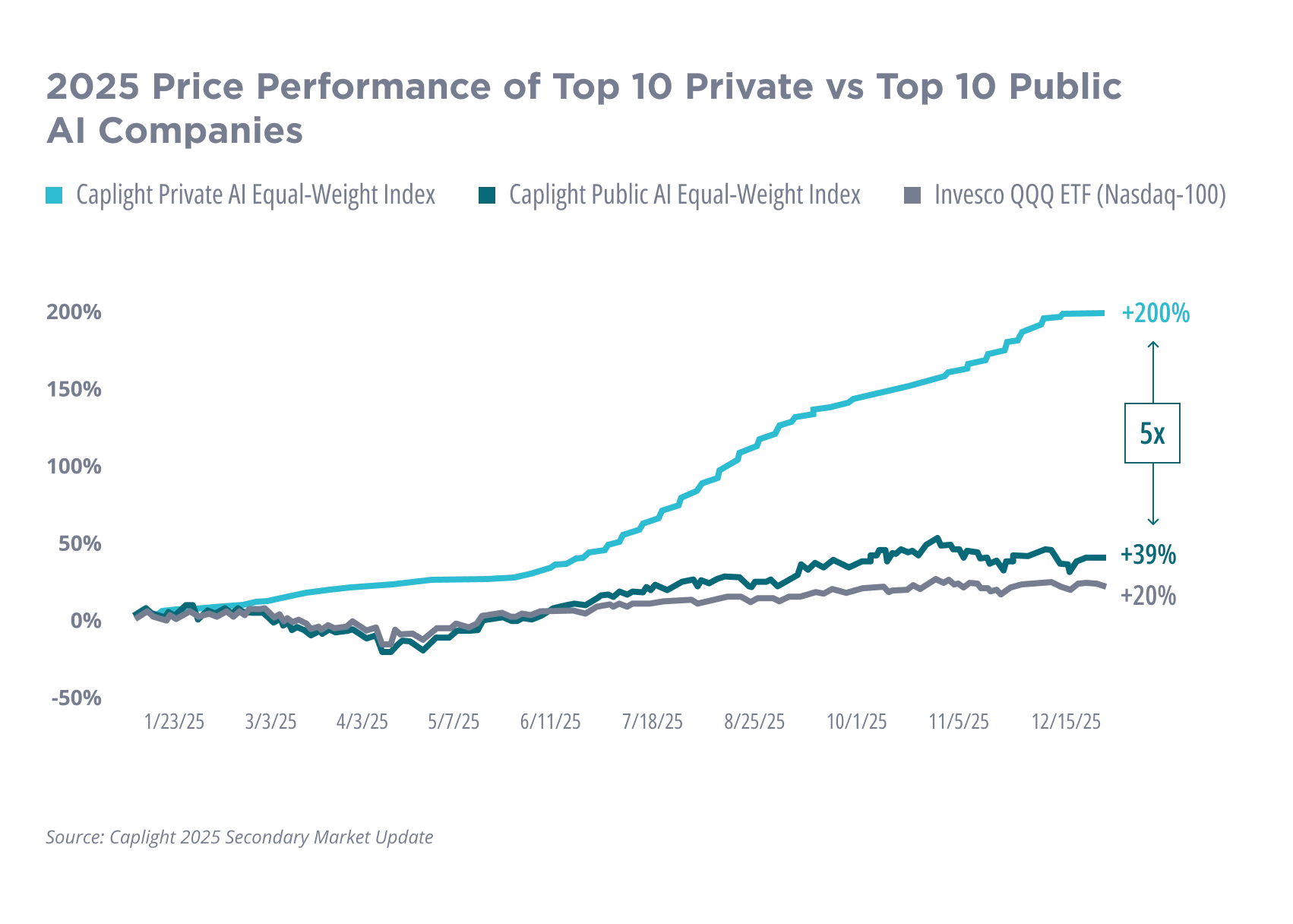
The performance gap between private and public AI companies has widened dramatically. In 2025, valuation gains accrued overwhelmingly to private AI leaders, while public AI names delivered far more modest returns. This divergence is structural, not cyclical. Most pure-play AI businesses remain private, and they are where model development, infrastructure buildout, and AI native monetization are happening fastest. Public market exposure, by contrast, is diluted by legacy revenue streams, slower decision cycles, and broader index constraints. As a result, the strongest AI value creation is occurring outside the reach of public-only portfolios.
This shift has important implications for how AI exposure is constructed. The Stableton Morningstar PitchBook Unicorn 20 strategy is centered around private blue-chip tech leaders, where AI-driven growth, valuation expansion, and long-term market leadership are compounding most directly.
THE UNTOLD UNICORN STORY
Kraken: Born from Bitcoin's biggest disaster
 Jesse Powell, co-founder and former CEO of Kraken. (34)
Kraken was founded in 2011 by Jesse Powell after he witnessed firsthand the chaos inside Mt. Gox, the world's largest Bitcoin exchange at the time. When Mt. Gox was hacked in June 2011, Powell flew to Tokyo on a last-minute flight, went straight from the airport to the company's offices without even dropping off his luggage, and spent weeks helping the exchange recover (35). What he saw convinced him the exchange was doomed.
Just one month later, he co-founded Kraken with Thanh Luu, building it as a secure alternative for when Mt. Gox inevitably collapsed. In 2020, Kraken became the first cryptocurrency company in U.S. history to receive a bank charter, and in March 2026, Kraken Financial became the first crypto-native bank to connect directly to the Federal Reserve. (36)
Fun Fact: Powell named the exchange after the legendary Norse sea monster because he wanted it to convey something intelligent, powerful, and secure. Kraken has never suffered a major security breach, outlasting competitors and dozens of other exchanges that have been hacked or collapsed over the years. (37)
Did you know? Kraken is one of the 20 companies in our Stableton Morningstar PitchBook Unicorn 20 strategy, a systematic, index approach that aims to outperform public benchmarks with low-cost fees, and without a performance fee. Click below for more information.
SOURCES
1 - Bloomberg, 2 - The Information, 3 - Tech Crunch, 4 - CNBC, 5 - Financial Times, 6 - Anthropic, 7 - The Information, 8 - Business Wire, 9 - Bloomberg, 10 - The Information, 11 - PR Newswire, 12 - Databricks, 13 - Wall Street Journal, 14 - Reuters, 15 - Kraken, 16 - The Information, 17 - Financial Times, 18 - The Verge, 19 - PYMNTS, 20 - PR Newswire, 21 - Bloomberg, 22 - The Guardian, 23 - The Block, 24 - Business Wire, 25 - CNBC, 26 - The Guardian, 27 - Wall Street Journal, 28 - Tech Crunch, 29 - Reuters, 30 - CNBC, 31 - Business Wire, 32 - PR Newswire, 33 - PR Newswire, 34 - Coindesk, 35 - Bloomberg, 36 - Reuters, 37 - Kraken



Every Wednesday, the Navigator delivers a digest of news from our portfolio holdings and key trends shaping private tech investing. Subscribe to receive it directly in your inbox.


