




Cursor Builds New AI Agent, Anduril Secures First NATO Contract, Anthropic Localizes Claude Pricing for India
By Stableton on July 15th, 2026
Private tech is moving fast this week. Cursor builds an AI agent to rival Claude Cowork, Anduril lands its first NATO contract, and Anthropic begins localizing Claude pricing for India. Let's dive in…
THIS WEEK’S BREAKING NEWS
Cursor builds AI agent ahead of SpaceX deal
Cursor is developing a general-purpose AI agent, internally called Sand, to compete with Anthropic's Claude Cowork, ahead of SpaceX's planned $60B acquisition of Cursor. The project follows Cursor's April deal leasing compute from SpaceXAI and the joint Grok 4.5 release. Cursor's revenue reached a $2.7B annualized pace as of March, while SpaceX posted $470M in Q1 AI solutions revenue. (1)
MARKET UPDATE
2026's IPO boom set to broaden past AI megadeals
U.S. IPO proceeds reached roughly $115.6B through H1 2026 per EY, led by SpaceX's record $86B raise at a nearly $1.8T valuation. SK Hynix's $26.5B ADR offering priced Thursday ranks among the largest foreign share sales, while General Atlantic and J.P. Morgan expect H2 to broaden into mid-cap sectors like advanced manufacturing, defense, and AI infrastructure. (2)
STABLETON MORNINGSTAR PITCHBOOK UNICORN 20 STRATEGY

The Stableton Morningstar PitchBook Unicorn 20 strategy is the world’s first passive, systematic, and semi-liquid approach to investing in the Top 20 privately held tech companies before they go public.
This strategy offers a straightforward and cost-effective way to gain exposure to leading private technology companies within a single portfolio. With no performance fees and enhanced liquidity, it offers a unique alternative to traditional private market investments.
STABLETON NEWS
Our Q2 2026 report is here
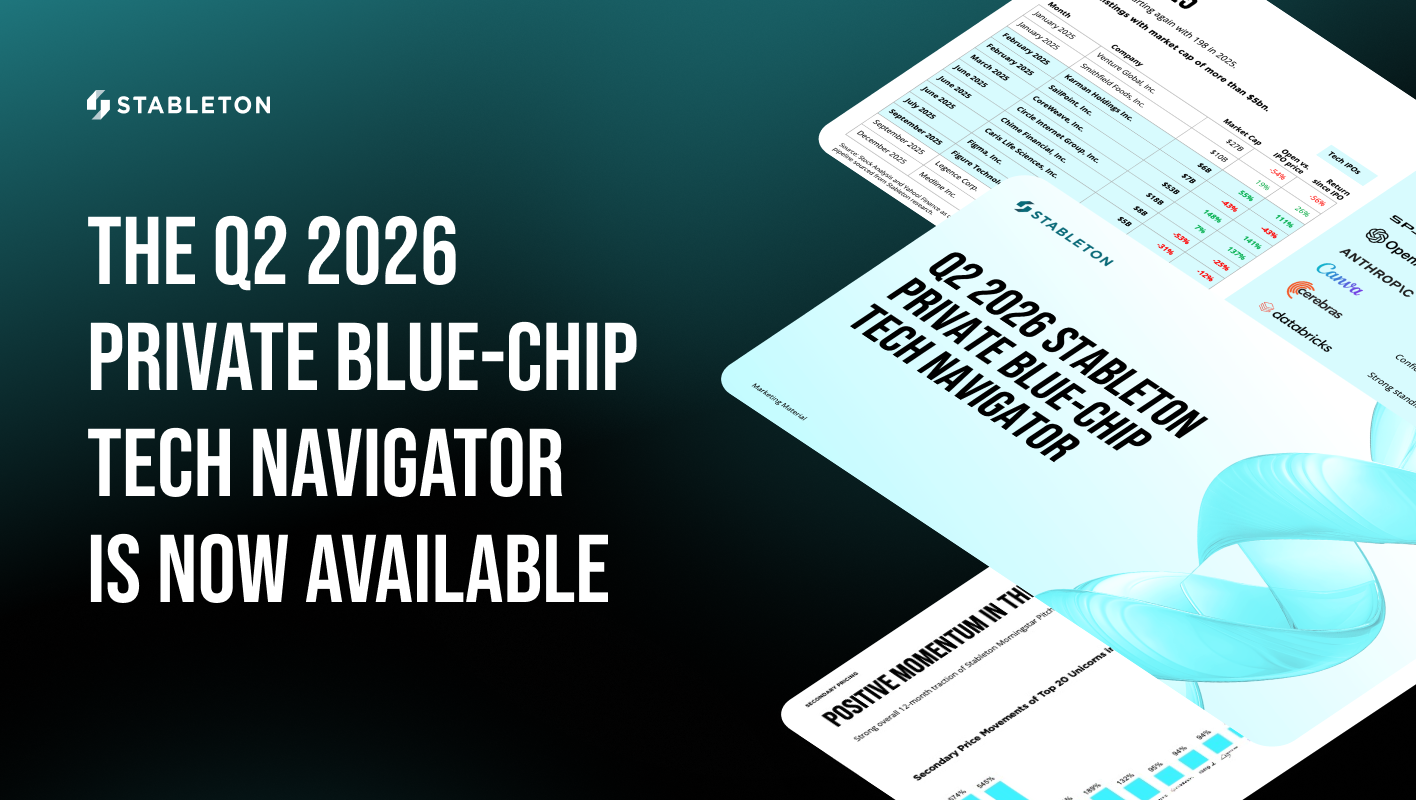
Q2 2026 was one of the biggest quarters we have seen in years.
We saw public market activity picking up significantly, with SpaceX completing the largest IPO in history and Cerebras going public in the same quarter. (3,4) Behind them, both OpenAI and Anthropic have now filed confidentially for their own listings. (5,6) Beyond the IPOs, we also saw a shift in deployment, from Figure AI’s robots entering commercial logistics to the Pentagon expanding classified AI contracts to eight top tech firms. (7,8)
Our latest Private Blue-Chip Tech Navigator breaks down what these new developments mean and where the market is moving next. Inside, we cover the quarter's largest funding rounds, secondary pricing trends, the upcoming IPO calendar, and more.
Download the full report here below.
PORTFOLIO NEWS
Anduril secures its first NATO contract for Lattice
NATO's Communications and Information Agency selected Anduril Industries to provide its Lattice platform for the Enhanced Air Command and Control (eAirC2) Data Platform initiative, marking Anduril's first NATO contract. During a nine-month evaluation phase, Anduril UK and its Europe team will deploy Lattice within NATO's environment, integrating air traffic control, surveillance, and force management across the alliance's 32 member countries. (9)
Anthropic brings Claude to physical AI with UST
Anthropic partnered with UST to embed Claude across chip validation, healthcare, telecom, and banking platforms, training 20,000 UST engineers and consultants worldwide. UST's iDEC platform already cuts validation cycle times by 50-70%, compressing four-day turnarounds into 48 hours, with Claude now serving as its reasoning layer to write regression tests and flag firmware regressions before production. (10)
Anthropic begins localizing Claude pricing for India's market
Anthropic is rolling out rupee-denominated pricing in India, its second-largest market at 5.8% of global Claude usage, with Claude Pro at ₹2,000/month (~$21) versus $17 in the U.S. and Claude Max at ₹11,999 (~$125) versus $100. The rollout, which lacks UPI support unlike OpenAI's, follows Anthropic's Bengaluru office opening and TCS and Infosys enterprise partnerships. (11)
Curinos deepens Databricks partnership for bank decision intelligence
Curinos became a Databricks Built-On partner, enabling bi-directional data integration for its Curinos One Decision Intelligence platform within banks' own governance environments. The Databricks-Curinos One Blueprint compresses time-to-value to 120 days, with customers reporting 130% higher average DDA balances, $1.6B in incremental new-to-bank balances, and 10x year-one ROI at partner institutions. (12)
Databricks taps Insignia to scale enterprise AI in Indonesia
Databricks appointed Indonesian consultancy Insignia to its invitation-only Delivery Provider Programme, making it only the second Indonesian-founded firm certified for the designation. Effective June 30, the partnership will establish a dedicated Delivery Unit targeting banking, fintech, retail, and state-owned enterprises, addressing Indonesia's gap between AI proof-of-concepts and production deployment using Databricks' lakehouse architecture and Unity Catalog governance. (13)
Kraken rebuilds its app around agentic trading
Kraken is rebuilding its app around agentic trading, giving users AI agents that monitor markets, identify opportunities, and execute trades in real time, though only with explicit customer confirmation. The onboarding flow uses AI to build draft portfolios based on user goals and risk tolerance. Kraken joins Coinbase and Gemini in the shift toward AI-native crypto platforms as it expands into payments, banking, and lending. (14)
Kraken debuts debit card for crypto spending
Kraken launched the Kraken Card for U.K. and EEA customers, a Mastercard-linked debit card enabling spending from crypto and cash balances across 600+ currencies with real-time conversion. The card offers up to 2% cash back in bitcoin, euros, or pounds with no transaction or ATM fees, building on last year's Krak Card, which offered 1% cash back rewards. (15)
OpenAI previews GPT-5.6 under government coordination
OpenAI began a limited preview of GPT-5.6 Sol, Terra, and Luna, coordinated with the U.S. government ahead of broader release. Sol sets a new state of the art on Terminal-Bench 2.1 and matches Mythos Preview on ExploitBench using roughly one-third the output tokens, though it doesn't cross the Cyber Critical threshold. Pricing spans $1-$5 input and $6-$30 output per 1M tokens. (16)
OpenAI, Google sell AI models to blacklisted groups
OpenAI and Google have been supplying AI services to Singapore-based subsidiaries of Alibaba, Baidu, and Tencent, companies on the U.S.'s 1260H military-linked blacklist. OpenAI suspended Alibaba-affiliated API access this month over suspected distillation. Anthropic, by contrast, bans Chinese-owned entities entirely and alleges Alibaba used 25,000 fraudulent accounts to generate 28.8M unauthorized Claude exchanges. (17)
OpenAI unveils "super app" ChatGPT Work amidst AI arms race
OpenAI launched ChatGPT Work, combining ChatGPT with Codex to let non-coders create documents, presentations, and websites, directly rivaling Anthropic's Claude Cowork. Powered by GPT-5.6, whose smallest version reportedly matches the largest at one-fifth the cost, the tool rolls out first to Pro, Enterprise, and Edu users as both companies compete for enterprise business ahead of possible IPOs. (18)
Perplexity builds stealth AI coding tool to rival Cursor
Perplexity has internally built an AI coding tool codenamed "Teammate," used by engineers since May, that could position the $20B-valued startup to compete with Cursor, Anthropic, and OpenAI in AI coding. The model-agnostic tool is designed for long-horizon engineering work, including owning projects and monitoring services, though Perplexity has not confirmed a public launch timeline. (19)
Perplexity adopts Nvidia's new Vera CPU for AI agents
Perplexity confirmed plans to use Nvidia's new Vera CPU, which the chip giant expects will generate $20B in sales by fiscal year-end as it challenges Intel and AMD. Perplexity VP Nate Kupp said Vera runs AI agent coding tasks about 1.5x faster than traditional CPUs, joining OpenAI, Anthropic, and Oracle as previously disclosed Nvidia CPU customers. (20)
Revolut's PRAGMA model powers fraud detection, credit, and service AI
Revolut's proprietary PRAGMA model, trained on 40B events across 25M users and powered by 200 NVIDIA H100 GPUs, delivered a 64.7% improvement in fraud detection, 16% gain in credit risk prediction, and 41% more effective product recommendations. The unified foundation model now supports over 70M users, up from 38M in 2023, alongside a customer service AI handling 75% of support requests unassisted. (21)
Revolut taps former Chase UK chief to lead EU bank
Revolut appointed former Chase UK CEO Kuba Fast to lead Revolut Bank UAB as the company shifts to a dual-hub structure spanning its Lithuanian-licensed bank and a new French banking hub across the EEA. Fast will oversee 55M European customers, while outgoing CEO Joe Heneghan moves up to lead the broader Revolut Holdings Europe ecosystem. (22)
SpaceX joins Nasdaq-100, shares slide 5.4%
SpaceX joined the Nasdaq-100 on Tuesday, just weeks after its June 12 IPO debut, one of the fastest inclusions ever, though shares fell 5.4% amid broader AI-stock jitters. The stock carries a 1.34% index weight and a $2T market cap, with Raymond James setting a Street-high $800 price target while CFRA holds the sole "sell" rating at $115. (23)
SpaceX's $6.5B Pentagon wins raise competition concerns
The U.S. Space Force awarded SpaceX nearly $6.5B across two contracts, $4.16B for AMTI surveillance satellites and $2.29B for the Space Data Network, drawing fresh pushback from Capitol Hill and industry groups like the SmallSat Alliance over sole-source reliance. The FY2027 budget request shows funding for multi-vendor networks shifted to SpaceX's Starshield backbone, a concentration debate intensifying after SpaceX's $75B IPO last month. (24)
Stripe files OpenUSD trademarks in South Korea
Stripe filed South Korean trademark applications for OpenStandard and OpenUSD on June 30, signaling stablecoin expansion plans as the country develops digital payment token regulations. The filings follow OpenStandard's existing roster of Korean partners, including Shinhan Financial Group, Samsung Electronics, and Kakao Bank, with Hyundai Card's vice chairman calling OpenUSD a potential "game changer" for stablecoins. (25)
xAI launches Grok 4.5 for coding, agentic tasks
xAI launched Grok 4.5, trained alongside Cursor across tens of thousands of NVIDIA GB300 GPUs, targeting coding, agentic tasks, and knowledge work. The model runs at 80 TPS with roughly 2x the token efficiency of comparable leading models, priced at $2 per million input tokens and $6 per million output tokens, and is now the default model in Grok Build. (25)
OTHER NEWS
ByteDance develops custom CPUs to power AI rollout
ByteDance is developing proprietary CPUs across Arm and RISC-V architectures to support its AI infrastructure and agentic Coze platform rollout, joining Google, Amazon, and Microsoft in custom silicon development. The move follows quarter-over-quarter Intel and AMD price hikes of 10-35%, as Nvidia targets a $200B CPU market with its new Vera chips. (27)
Celonis, Mythics pair AI intelligence with Oracle Cloud migrations
Mythics partnered with Celonis to embed process intelligence into Oracle Cloud transformations, replacing assumption-based discovery with real-time, data-driven analysis of transactional data. The partnership targets federal, state, local government, higher education, healthcare, and commercial clients, enabling continuous post-transformation monitoring to de-risk migrations and quantify business value earlier in the transformation lifecycle. (28)
Crusoe adds serverless fine-tuning to its cloud platform for AI teams
Crusoe launched Serverless Fine-Tuning and Self-Serve Deployments within its Intelligence Foundry platform, letting teams fine-tune open-weight models and deploy to production on NVIDIA H100/H200 GPUs without managing infrastructure. Pricing is token-based for fine-tuning and billed by GPU hour for deployments, with early customers including Yutori, Nous Research, and StackOne, general availability begins next week. (29)
Harmattan, Dassault unveil new EW drone payload NAMIB
Harmattan and Dassault unveiled NAMIB, a co-developed electronic warfare drone payload that detects, identifies, and geolocates air defense emissions, successfully tested in a simulated kill chain with a Rafale F4 fighter at meter-level precision. Built in under six months, it marks the first joint project since Dassault led Harmattan's $200M Series B in January at a $1.4B valuation. (30)
Isar Aerospace signs agreement for launch pad in Canada
Isar Aerospace and Maritime Launch Services agreed to build a dedicated launch pad for the Spectrum rocket at Spaceport Nova Scotia, Canada's first spaceport. The deal expands Isar Aerospace's global launch capacity while advancing Canada's sovereign space access, following Isar's earlier German launch site agreement with Planet Labs Germany at Andøya Spaceport in Norway. (31)
Lovable in talks to double its valuation to $13.2B
Lovable is in talks to raise $300M at a $13.2B valuation, exactly double its $6.6B mark from last December, with Menlo Ventures expected to lead. The Swedish vibe-coding startup hit $500M in annualized revenue in June and counts Workday, Asana, and Nvidia among its enterprise customers, joining rivals Replit ($9B) and Factory ($1.5B) in the sector's rapid valuation climb. (32)
Mistral launches first robotics model in physical AI push
Mistral AI unveiled its first robotics model, pushing into factories, warehouses, and industrial automation as Europe's leading AI company expands into physical AI. The launch follows Mistral's May acquisition of Austrian startup Emmi AI and comes months after Paris-based Genesis AI unveiled its own robotics model with navigation and manipulation capabilities. (33)
Polymarket seeks license for margin trading in the US
Polymarket filed for a futures commission merchant license via affiliate Coming Home GBA LLC to offer margin trading, targeting institutional traders with non-fully collateralized positions pending CFTC approval. The move follows Kalshi's own FCM license, which drove $5.5B in perpetuals volume within two weeks. Polymarket's weekly notional volume hit a record $4B in June. (34)
CHART OF THE WEEK
The biggest pools of capital are quietly going private
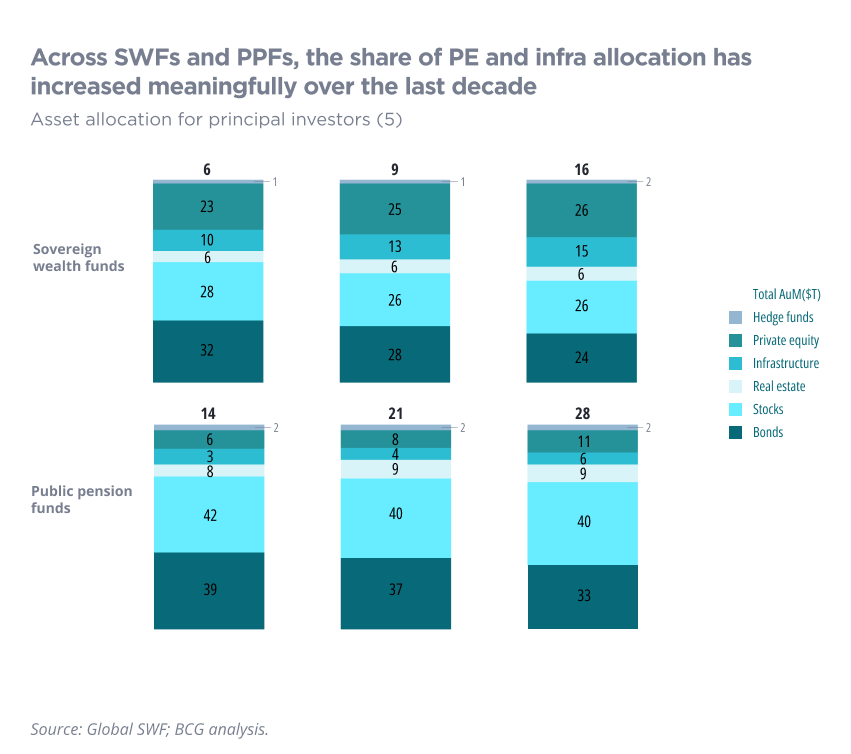
The world's most cautious investors are getting more comfortable with private markets.
Sovereign wealth funds and public pension funds have spent the last decade steadily shifting money out of stocks and bonds and into private equity and infrastructure.
Some of the most risk-conscious capital in the world has concluded that long-duration private assets are where diversification, inflation protection, and control over capital now live. As allocations have grown, so has conviction, and these institutions have moved beyond writing checks into funds. They're co-investing, doing direct deals, and getting closer to the assets themselves.
That shift matters for where the money goes next. As allocation and conviction rise together, more long-term capital is flowing directly into infrastructure, technology, and other private sectors, expanding the pool of capital available to private companies.
The Stableton Morningstar PitchBook Unicorn 20 strategy sits right at that intersection, giving investors exposure to private blue-chip technology leaders in the same space where institutional capital is going.
THE UNTOLD UNICORN STORY
Cursor: From MIT project to the future of coding
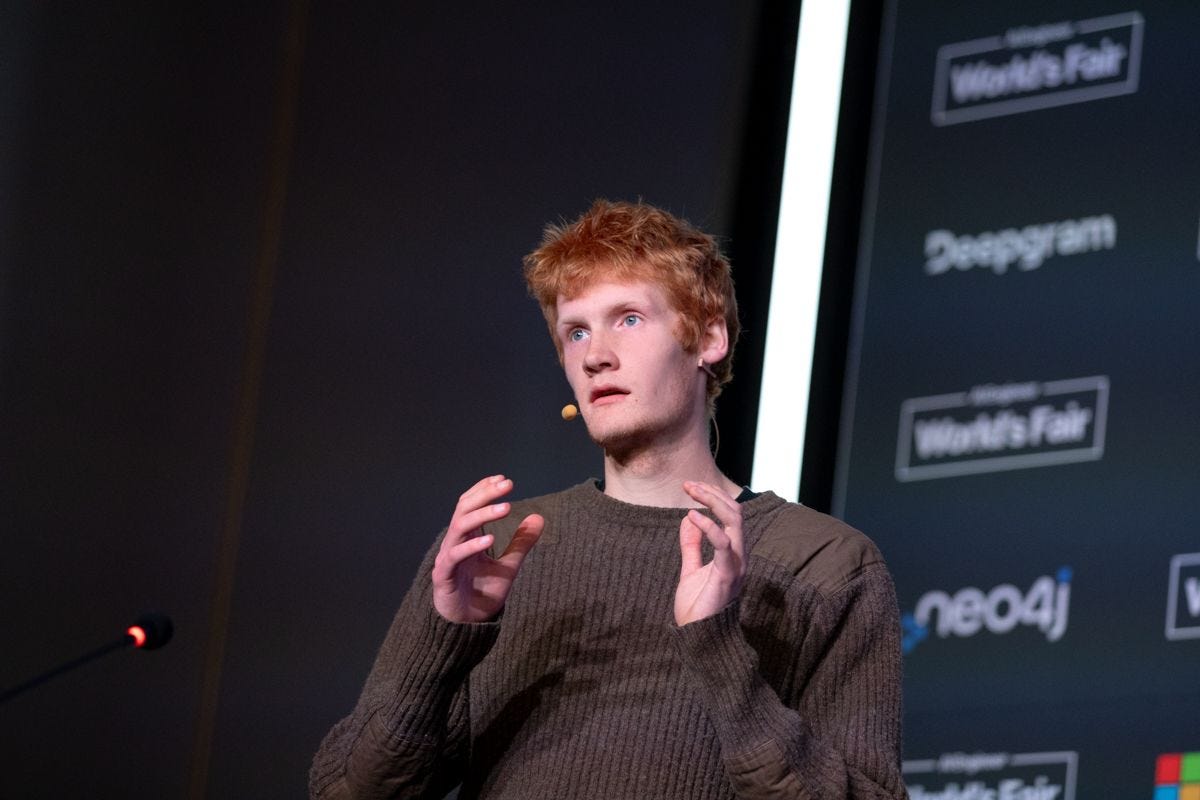 Co-founder and CEO, Anysphere, Michael Truell, at a convention talk. (35)
When Michael Truell and his co-founders launched Anysphere in 2022, they weren't chasing unicorn status; they were solving their own frustration. Long hours spent debugging and rewriting the same functions led them to an idea: what if AI could help developers reason through entire projects, not just autocomplete lines? That experiment led to Cursor, Anysphere’s AI-powered development environment that thinks like a collaborator.
The idea took off. Its platform now powers workflows for teams across the Fortune 500, helping engineers code faster and smarter. Cursor is shaping a new reality where writing software feels less like typing commands and more like talking to an intelligent partner.
Fun Fact: Anysphere prohibits the use of AI tools during the first round of coding interviews, which is a notable irony for a company whose entire product is an AI coding assistant. (36)
Did you know? Cursor is one of the 20 companies in our Stableton Morningstar PitchBook Unicorn 20 strategy, a systematic, index approach that aims to outperform public benchmarks with low-cost fees, and without a performance fee. Click below for more information.
SOURCES
1 - The Information, 2 - Fortune, 3 - NPR, 4 - CNBC, 5 - The Guardian, 6 - Bloomberg, 7 - Figure AI, 8 - The Guardian, 9 - Anduril, 10 - Anthropic, 11 - TechCrunch, 12 - PR Newswire, 13 - Marketing Interactive, 14 - CNBC, 15 - PYMNTS, 16 - OpenAI, 17 - Financial Times, 18 - Reuters, 19 - Business Insider, 20 - Reuters, 21 - Forbes, 22 - FF News, 23 - Al Jazeera, 24 - Space News, 25 - DeFi Planet, 26 - xAI, 27 - Reuters, 28 - PR Newswire, 29 - Crusoe, 30 - Tectonic Defense, 31 - Reuters, 32 - TechCrunch, 33 - Reuters, 34 - Bloomberg, 35 - The Signal, 36 - Tech Funding News


Every Wednesday, the Navigator delivers a digest of news from our portfolio holdings and key trends shaping private tech investing. Subscribe to receive it directly in your inbox.


