




SpaceX, OpenAI & Anthropic Prepares for IPOs, Neuralink Prepares High-Volume Production, OpenAI Secures $41B from SoftBank
By Stableton on January 6th, 2026
This week feels like a turning point. Big private blue-chip companies are edging closer to public markets, scaling fast, and reshaping how capital finds growth. Let’s dive in…
THIS WEEK’S BREAKING NEWS
SpaceX, OpenAI and Anthropic may redefine the IPO cycle
The Financial Times reports that SpaceX, OpenAI, and Anthropic are preparing IPOs as early as 2026, with combined proceeds expected in the tens of billions of dollars, potentially exceeding the total raised by ~200 US IPOs in 2025. OpenAI is valued at $500B and discussing funding at $750B+, SpaceX’s secondary implies $800B, and Anthropic is expected above $300B. Even one listing could eclipse recent tech IPO volumes. (1)
MARKET UPDATE
China’s AI IPO surge vs. US private lockup
China’s AI market is seeing a pronounced shift toward public listings, as multiple AI and chip companies pursue IPOs early in their lifecycle, yielding strong debut performance (e.g., Moore Threads up ~500%, MetaX ~700%). This contrasts sharply with the U.S., where major AI leaders like OpenAI and Databricks remain private with massive valuations, limiting public investors’ direct exposure and withholding the real-time price discovery that comes from public markets. (2)
STABLETON MORNINGSTAR PITCHBOOK UNICORN 20 STRATEGY

The Stableton Morningstar PitchBook Unicorn 20 strategy is the world’s first passive, systematic, and semi-liquid approach to investing in the Top 20 privately held tech companies before they go public.
This strategy offers a straightforward and cost-effective way to gain exposure to leading private technology companies within a single portfolio. With no performance fees and enhanced liquidity, it offers a unique alternative to traditional private market investments.
PORTFOLIO NEWS
Neuralink shifts from breakthrough to scaled production
Elon Musk said Neuralink will begin high-volume production of its brain–computer interface devices in 2026, alongside an almost fully automated implantation procedure. The company has already implanted chips in 12 patients globally and aims to scale toward thousands of patients, transitioning from experimental trials to manufacturing and operational execution. The move signals Neuralink’s progression from frontier R&D to early-stage industrialization of neurotechnology. (3)
SoftBank completes $41B investment in OpenAI
SoftBank has fully funded a ~$40–41 billion investment in OpenAI, completing the final payment tranche and cementing one of the largest AI sector investments ever. This transaction deepens SoftBank’s strategic AI positioning and mitigates investor concerns about funding delivery, underpinning OpenAI’s expansion capacity amid broad sector capital needs. (4)
OpenAI turns to M&A to secure distribution
OpenAI is exploring the acquisition of Pinterest as a potential large-scale distribution and data play, according to The Information. The deal would give OpenAI access to hundreds of millions of users, rich visual-intent data, and a consumer-facing platform outside search. It signals a strategic pivot toward owning distribution, not just models, as AI competition intensifies. (5)
OpenAI pushes audio AI toward consumer hardware
OpenAI is accelerating investment in audio-first AI models ahead of a potential consumer device launch, focusing on real-time voice interaction, multimodal integration, and lower latency. The effort reflects a shift from text-centric interfaces toward ambient, conversational computing, positioning audio as a primary user interface. The strategy signals OpenAI’s ambition to control both the AI layer and the end-user experience. (6)
ChatGPT aids health insurance navigation
OpenAI says 40 million+ users globally turn to ChatGPT daily for health information and insurance guidance, with >5% of all queries healthcare-related. Users are uploading bills, comparing coverage plans, and spotting billing errors - filling gaps left by rising premiums and the expiration of enhanced ACA subsidies. Risks include inaccurate medical advice and unresolved liability/data security concerns as reliance grows. (7)
Samsung and Perplexity “Hey Plex” integration
A teardown of Perplexity’s latest Android APK reveals support for a potential “Hey Plex” wake-word trigger, suggesting deeper integration of Perplexity AI as a voice assistant on Samsung Galaxy devices. Clues also imply Perplexity could be pre-installed on flagship devices like the upcoming Galaxy S26 series, enhancing on-device AI activation and user engagement. (8)
Audi and Revolut launch their F1 works team
Audi and Revolut have officially revealed the Audi Revolut F1 Team, announcing a global launch event in Berlin on January 20, 2026 ahead of their debut in the Formula One World Championship. The partnership extends beyond sponsorship, embedding Revolut’s financial tools into team operations and marking a strategic convergence of high-performance engineering and digital finance. (9)
Ripple expands XRPL adoption with Japanese banks
Ripple Labs is partnering with major Japanese financial institutions including Mizuho Bank, SMBC Nikko, and Securitize Japan to accelerate institutional adoption of the XRP Ledger (XRPL). The collaboration targets real-world use cases such as cross-border payments, stablecoins, and RWA tokenization, lending the blockchain ecosystem deeper integration with regulated finance in a crypto-supportive regulatory environment. (10)
SpaceX acts on rising orbital collision risk
SpaceX will lower roughly 4,400 Starlink satellites from ~550 km to ~480 km throughout 2026 to cut collision risk amidst rapidly increasing low-Earth-orbit congestion and a recent debris-generating anomaly. Lower altitudes shorten orbital lifetimes by >80 % and place satellites where fewer debris and competing constellations exist, boosting safety and lowering cascading collision probabilities. (11)
xAI doubles down on compute scale
xAI has acquired a building to develop its third supersized data center, deepening its vertical integration into AI infrastructure. The move reflects rising compute intensity behind frontier model training and inference, as xAI scales capacity alongside rivals investing tens of billions into data centers. Control over physical infrastructure positions xAI to reduce dependency on third-party cloud providers. (12)
OTHER NEWS
Brex bets on autonomous AI agents
Brex is shifting from centralized AI orchestration toward an “Agent Mesh” architecture, where narrow, role-specific AI agents operate independently yet cooperatively, reducing workflow rigidity and enabling enterprise automation across finance functions like spend management and expense processing. This modular mesh aims to raise automation toward 99%, moving beyond traditional orchestrators to flexible, auditable, and autonomous systems. (13)
Celonis challenges SAP patents in court
Celonis has filed a motion in Delaware federal court to dismiss parts of SAP’s lawsuit by arguing that two contested data-processing patents improperly claim unpatentable mathematical concepts executed on generic computers. The move marks a legal strategy to undercut SAP’s claims and preserve competitive access to core process-mining technologies. (14)
Polymarket & Parcl launch real-estate prediction markets
Polymarket and Parcl are partnering to launch real estate prediction markets that settle against Parcl’s daily housing-price indices, offering a transparent, data-driven reference for forecasting property price movements. Initial markets focus on major U.S. metros with standardized templates and independent settlement values, lowering complexity in expressing directional views on housing trends. (15)
CHART OF THE WEEK
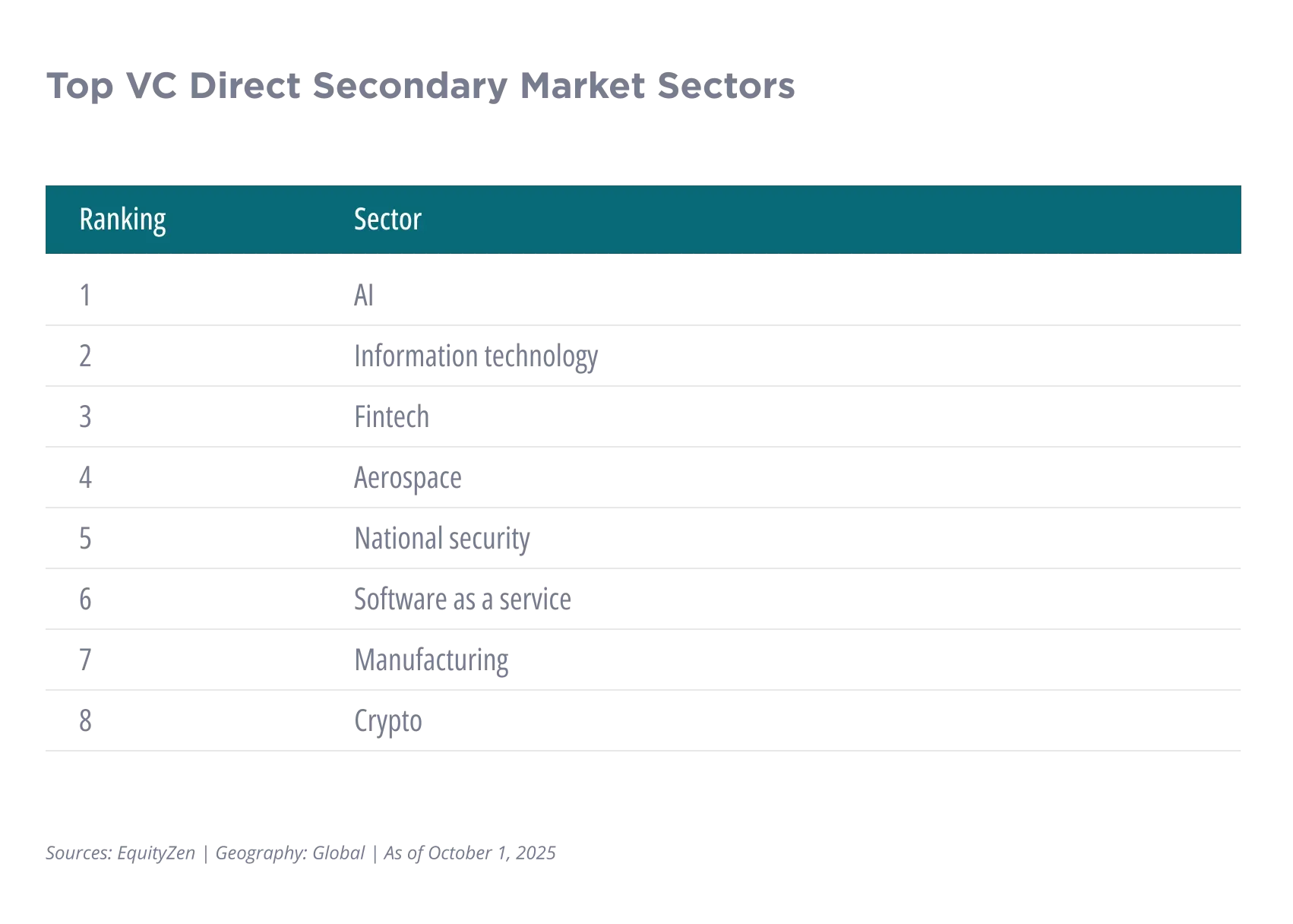
Capital in the secondary market is more selective than ever, and the rankings highlight where conviction truly sits. AI leads by a wide margin because institutions view it as the central engine of long term enterprise value. Information technology and fintech follow closely, reflecting continued demand for core infrastructure like cloud systems, data processing, and financial rails. Deep tech categories such as aerospace and national security also appear near the top, showing that investors are allocating to sectors supported by long planning cycles, government contracts, and durable structural demand.
This concentration tells a clear story. Investors are focusing on scalable, mission critical companies rather than spreading capital across the full venture landscape. The Stableton Morningstar PitchBook Unicorn 20 gives institutional investors, banks, wealth managers, and family offices systematic exposure to private blue-chip technology leaders that sit at the intersection of these powerful and persistent market themes.
THE UNTOLD UNICORN STORY
Stripe was once upon a time a $10/day idea
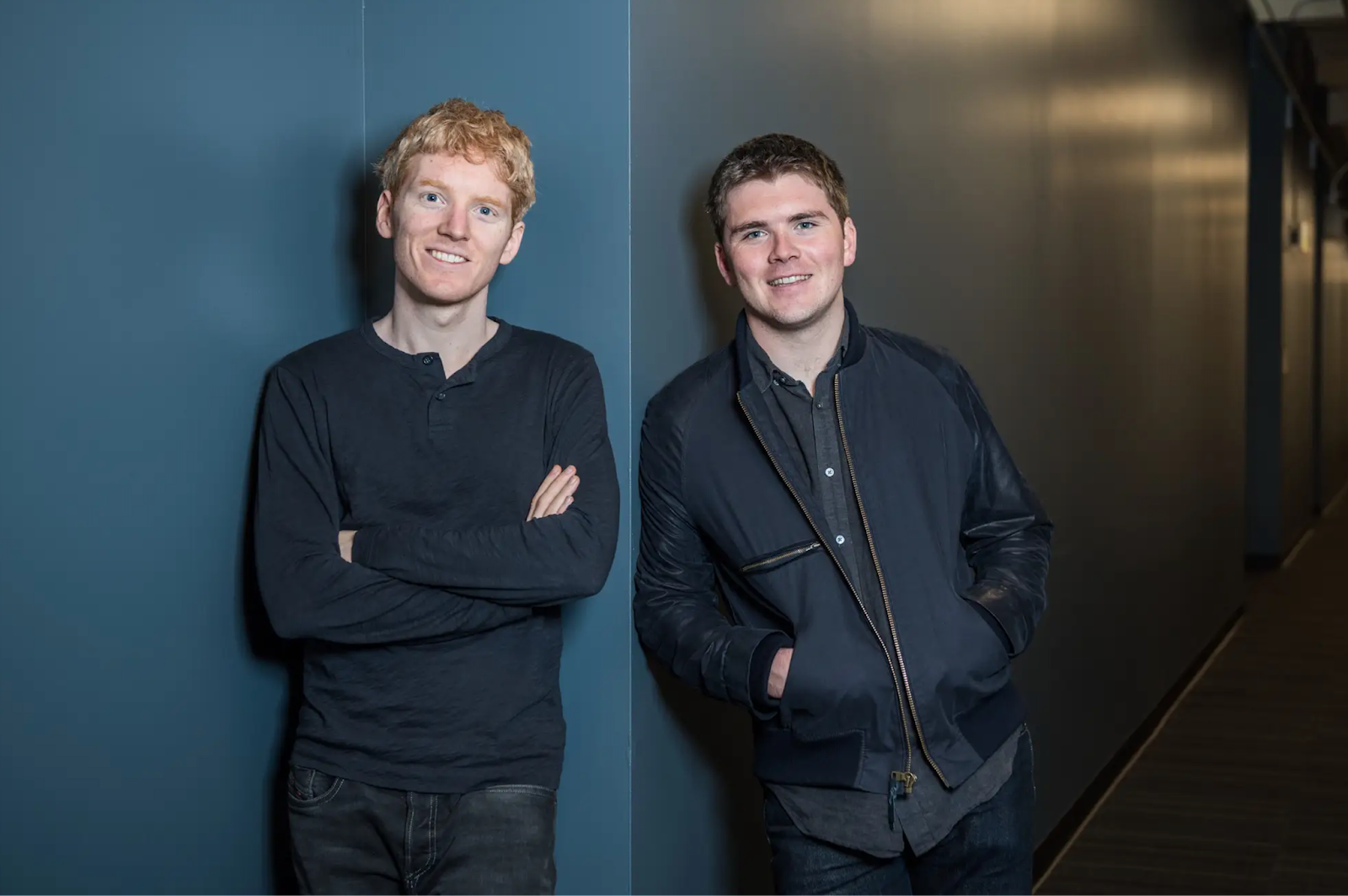
Stripe co-founders, Patrick and John Collison (16)
The Collison brothers, Patrick and John, started Stripe in 2010 during a winter break in Buenos Aires, turning their idea into a reality with just $10 a day. They crafted developer-friendly payment APIs that solved a real headache for online businesses. Their hands-on approach—personally helping new users install Stripe—created buzz, and soon, they secured $2 million from top investors. By 2011, Stripe had launched, revolutionizing online payments with simplicity and speed.
Fun Fact: Patrick was 17 and John was only 15 when they got accepted into the fourth ever batch of Y Combinator (W07). (17)
Did you know? Stripe is one of the 20 companies in our Stableton Morningstar PitchBook Unicorn 20 strategy, a systematic, index-like approach that aims to outperform public benchmarks with low-cost fees, and without a performance fee. Click below for more information.
SOURCES
1 - The Financial Times, 2 - CNBC Television, 3 - Business Insider, 4 - CNBC, 5 - The Information, 6 - The Information, 7 - Axios, 8 - Android Authority, 9 - Stupid DOPE, 10 - Cryptopolitan, 11 - Euro News, 12 - The Information, 13 - VentureBeat, 14 - Bloomberg Law, 15 - Globe News Wire, 16 - Business Insider, 17 - First 1000



Every Wednesday, the Navigator delivers a digest of news from our portfolio holdings and key trends shaping private tech investing. Subscribe to receive it directly in your inbox.


