




Databricks Raises $1.8B Debt, OpenAI Courts $50B Middle East Capital, Stripe Slows IPO Plans
By Stableton on January 28th, 2026
This week highlights how late-stage tech leaders are funding scale. Debt, sovereign capital, and delayed IPOs signal a market optimizing for control, flexibility, and long-term execution. Let’s dive in…
THIS WEEK’S BREAKING NEWS
Databricks strengthens IPO runway with $1.8B debt
Databricks has secured $1.8B in additional debt, bringing its total debt capacity to over $7B, as it prepares for a potential IPO as early as 2026. The company reported $4.8B in annualized revenue growing over 55% year over year, positive free cash flow, and subscription gross margins above 80%. The financing adds balance-sheet flexibility following its $134B valuation raise. (1)
MARKET UPDATE
Strong debut listings reignite European IPO pipeline
Europe’s IPO market recorded its strongest-ever start to a year in 2026, driven by a €3.8 billion flotation from Czechoslovak Group and several other listings that revived investor confidence. Dealogic data showed January fundraising reached its fastest pace since at least 1995, with five IPOs raising roughly a quarter of 2025’s total. Bankers pointed to improving valuations, defence, industrials, and private equity exits as key drivers. (2)
STABLETON MORNINGSTAR PITCHBOOK UNICORN 20 STRATEGY

The Stableton Morningstar PitchBook Unicorn 20 strategy is the world’s first passive, systematic, and semi-liquid approach to investing in the Top 20 privately held tech companies before they go public.
This strategy offers a straightforward and cost-effective way to gain exposure to leading private technology companies within a single portfolio. With no performance fees and enhanced liquidity, it offers a unique alternative to traditional private market investments.
PORTFOLIO NEWS
Anduril expands with $1B California defense campus
Anduril will invest an additional $1B to build a 1.18m sq ft defense campus in Long Beach, spanning R&D, engineering, and prototype manufacturing. The site is expected to employ around 5,500 workers and anchor next-generation autonomous defense programs. The expansion underscores Anduril’s transition from R&D-led scale-up to industrialized defense manufacturing. (3)
Anduril partners with Dirac for AI-driven manufacturing coordination
Anduril has selected Dirac as its core partner for AI-driven work instruction authoring across its manufacturing operations under a multi-year agreement. Early deployments reduced instruction authoring time by 87.5%, compressing a 12-hour process into 90 minutes. The partnership addresses a core manufacturing coordination bottleneck, enabling faster design iteration, production scaling, and throughput without proportional headcount growth. (4)
Anthropic publishes a new governing framework for Claude
Anthropic has published a new, expanded constitution for Claude that moves beyond rule-based principles toward value-driven reasoning. The document directly guides model training, synthetic data generation, and behavioral evaluation, prioritizing safety, ethics, compliance, and genuine helpfulness. By releasing it publicly under a CC0 license, Anthropic positions transparency and governance as core infrastructure for scaling powerful AI systems. (5)
Anthropic CEO challenges export policy despite Nvidia ties
Anthropic CEO Dario Amodei drew attention at Davos by sharply criticizing U.S. policy allowing advanced Nvidia AI chips to be exported to China. He argued the decision poses serious national security risks, likening it to enabling strategic rivals through critical infrastructure. The comments are notable given Nvidia’s close commercial ties to Anthropic, highlighting rising tension between AI geopolitics and industry partnerships. (6)
Analysts peg Zoom’s Anthropic investment at up to $4B
Analysts at Baird estimate Zoom’s minority investment in Anthropic could now be worth $2B to $4B, driving an 11% jump in Zoom shares. The stake likely stems from a $51M strategic investment made in 2023 via Zoom Ventures. With Anthropic valued around $350B, analysts suggest Zoom could be sitting on a roughly 78x return as IPO speculation builds. (7)
Anthropic launches interactive Claude apps for workplace tools
Anthropic has launched interactive apps inside Claude, allowing enterprise users to access workplace tools such as Slack, Canva, Figma, Box, and Clay directly within the chatbot. Built on the Model Context Protocol, the apps enable authenticated actions like messaging, file access, and content creation. The feature is available to paid tiers and is designed to pair with Anthropic’s Cowork agent for multi-step workflows. (8)
Salt Security extends API security into Databricks’ data stack
Salt Security has expanded its platform with two new integrations, introducing a Databricks Connector for API-level visibility into AI agent behavior and a Netlify Collector for edge-based applications. The additions extend Salt’s “Universal Visibility” strategy, allowing security teams to monitor APIs across AI workloads, data platforms, and modern edge architectures. The move targets blind spots left by infrastructure-focused security tools. (9)
Deel integrates with Aspire to unify global hiring and finance
Aspire has partnered with Deel to integrate Employer of Record capabilities directly into its financial platform, unifying global payroll, hiring, treasury, and FX operations. The collaboration creates a single system for managing cross-border teams, combining Deel’s compliance infrastructure with Aspire’s multi-currency financial stack. The integration aims to give finance and HR teams real-time visibility into workforce costs, cash flow, and hiring decisions. (10)
Court reveals expanded Epic–Google services agreement amidst settlement talks
A U.S. judge revealed that Epic Games and Google have a previously undisclosed partnership tied to their ongoing antitrust settlement, involving Unreal Engine, Fortnite, and Android. The deal includes joint development and marketing commitments, with Epic expected to spend around $800M over six years on Google services. The court is scrutinizing whether this partnership influenced Epic’s stance on broader Android ecosystem reforms. (11)
Kraken launches DeFi Earn across US, EU, and Canada
Kraken has launched DeFi Earn across the U.S., EU, and Canada, giving centralized exchange users access to on-chain yield via Veda-powered vaults. The product offers variable APYs of up to 8%, with Chaos Labs and Sentora managing initial USDC vaults deployed into protocols such as Aave and Morpho. Kraken positions the rollout as a bridge between institutional-grade risk controls and DeFi accessibility. (12)
OpenAI launches "OpenAI for Countries" to push global AI usage
OpenAI has launched the OpenAI for Countries initiative to encourage governments to expand AI infrastructure and deepen adoption across education, health, and disaster preparedness. Eleven countries have joined, with models ranging from nationwide education deployments to data center partnerships. OpenAI argues most governments significantly underuse existing AI capabilities, pointing to wide gaps in adoption both between and within countries. (13)
OpenAI courts Middle East capital for $50B round
OpenAI CEO Sam Altman is in early discussions with Middle Eastern investors to raise $50B or more in a new funding round, targeting a valuation of roughly $750B to $830B. Talks include state-backed funds in Abu Dhabi and follow recent fundraising discussions with Amazon. The capital would support massive spending on AI chips, data centers, and talent amid intensifying competition. (14)
OpenAI tests premium pricing in early ChatGPT ads
OpenAI has begun an early advertising rollout in ChatGPT, pricing ads at premium rates comparable to top-tier streaming inventory while offering limited targeting and measurement tools. Initial formats focus on impressions rather than performance, with ads appearing below responses. The strategy targets enterprise advertisers first as OpenAI tests ads as a meaningful revenue stream alongside subscriptions and checkout commissions. (15)
Ramp brings real-time budgeting to finance with Ramp Budgets
Ramp has launched Ramp Budgets, an AI-powered tool that links company budgets directly to live spend, giving finance teams real-time visibility without spreadsheets. The product maps expenses, bills, reimbursements, and POs to budget lines as spending occurs, adding approval context and automated controls. Ramp says most companies currently detect overruns only after funds are spent, making real-time budgeting a core efficiency gain. (16)
Revolut drops U.S. bank acquisition for license push
Revolut has abandoned plans to acquire a U.S. bank and will instead pursue a standalone American banking license, betting on faster approvals under the Trump administration’s deregulatory stance. The fintech concluded that a takeover could be complex due to regulatory hurdles and branch commitments. The shift reflects broader interest among fintechs in de novo licenses as U.S. regulators signal greater openness. (17)
Ripple CEO forecasts new crypto all-time highs in 2026
Ripple CEO Brad Garlinghouse said he expects the crypto market to reach new all-time highs in 2026, reiterating a bullish outlook despite recent price declines. He previously forecast Bitcoin could trade at $180,000 by the end of 2026, citing regulatory tailwinds such as the proposed U.S. crypto market structure bill. XRP, which hit a record in 2025, remains well below its peak. (18)
SpaceX targets mid-March test of upgraded Starship V3
SpaceX is targeting mid-March for the first test flight of its upgraded Starship V3 rocket after delays caused by a booster explosion during ground testing. The larger, more powerful version is designed to launch heavier next-generation Starlink satellites and enable in-orbit docking. Starship remains central to SpaceX’s lunar ambitions and future IPO plans, even as competition from Blue Origin intensifies. (19)
Stripe keeps IPO plans on hold amid rapid growth
Stripe does not plan to go public in the near term, according to co-founder and president John Collison, who said the company is prioritizing growth amid rapid industry change. Speaking in Davos, Collison highlighted agentic commerce and stablecoins as key accelerants, noting rising adoption following regulatory shifts. Stripe has deepened its stablecoin push, including a $1.1B acquisition of Bridge, positioning itself as core payments infrastructure. (20)
OTHER NEWS
ByteDance creates U.S. entity under American investor control after ownership deal
TikTok and ByteDance have finalized a deal creating a new U.S.-based entity majority-owned by American investors, securing the app’s continued operation in the U.S. and averting a nationwide ban. Oracle, Silver Lake, and MGX will collectively own 50%, with ByteDance retaining a minority stake. The arrangement concludes a yearslong regulatory dispute over data security, governance, and geopolitical risk. (21)
Celonis takes process intelligence agenda to WEF Davos
Celonis participated in the World Economic Forum Annual Meeting 2026, where its leadership positioned process intelligence as a prerequisite for moving from AI experimentation to measurable return on AI investment. At Davos, the company emphasized open, system-agnostic processes to give AI cross-system context, strengthen governance, and enable reliable execution at scale across enterprises and the public sector. (22)
Lenovo partners with Mistral and others for multi-LLM AI strategy
Lenovo said it was pursuing partnerships with multiple large language model providers, including Europe’s Mistral AI, as part of a global strategy to embed AI across its devices. Speaking in Davos, CFO Winston Cheng said Lenovo’s Qira system was designed to integrate regional LLM partners such as Mistral, Humain, Alibaba, and DeepSeek, reflecting regulatory diversity and an orchestrator-led approach rather than developing proprietary models. (23)
DAZN partners with Polymarket to bring predictions on-air
DAZN partnered with Polymarket to integrate real-time prediction market data into its live U.S. sports broadcasts, allowing viewers to interact with probabilities directly on the platform alongside DAZN Bet. The streaming group said it planned to apply for CFTC approval to enable prediction trading in the U.S., potentially expanding internationally. The move came as regulators increased scrutiny, highlighted by a Massachusetts ruling restricting sports-event prediction markets. (24)
Shield AI and LIG Nex1 formalize drone weapons partnership
Celonis is enabling AI-driven transformation at Fujitsu by applying process intelligence across inventory management at its FSAS Technologies unit. The platform delivered a 20% reduction in excess inventory and a 50% drop in inventory orders within six months, generating multi-million-dollar savings. Fujitsu is now scaling process intelligence enterprise-wide to ground AI deployment in operational context and execution.(25)
CHART OF THE WEEK
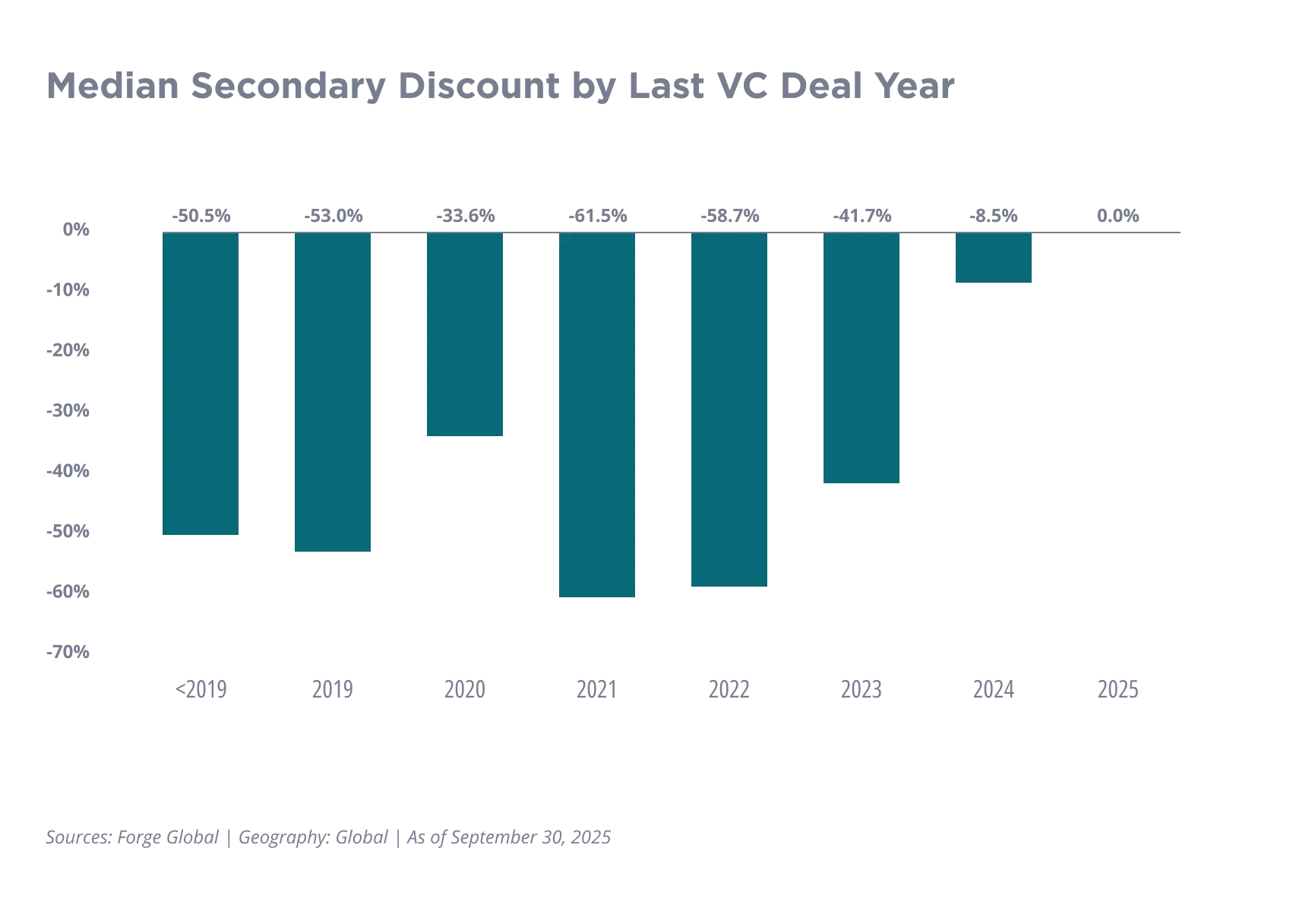
The relationship between a company’s last primary round and its secondary discount has become unmistakable. Pandemic-era valuations remain the most heavily penalized, with 2021 and 2022 vintages trading at steep discounts as the market continues to correct the excesses of that period. By contrast, companies that raised capital recently are holding their value. Deals priced in 2024 show only modest discounts, and 2025 rounds are clearing near parity. The market is signaling something clear. Fresh pricing is trusted. Stale pricing is not.
In an environment defined by valuation gaps, disciplined exposure matters. The Stableton Morningstar PitchBook Unicorn 20 focuses on companies that demonstrate real scale, transparency, and credible pricing. Institutional investors, banks, wealth managers, and family offices gain exposure to a systematic strategy and a cost-efficient, semi-liquid structure.
THE UNTOLD UNICORN STORY
Applied Intuition: Powering the infrastructure behind autonomous intelligence
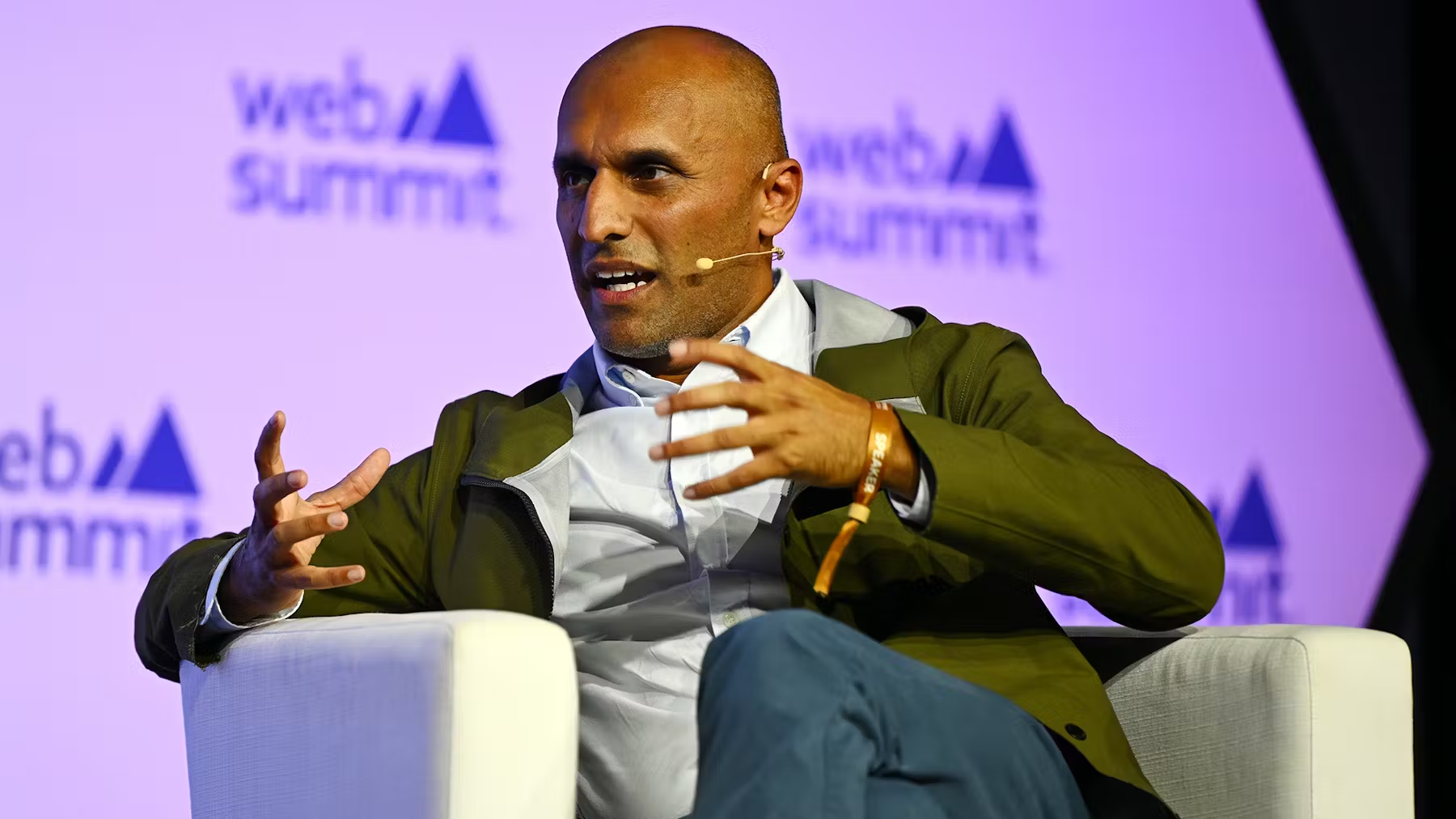
Applied Intuition CEO, Qasar Younis. (26)
Applied Intuition is advancing the global shift toward autonomy through sophisticated simulation and development software. Founded in 2017 by Qasar Younis and Peter Ludwig, the company enables developers to design, test, and validate complex autonomous systems safely and efficiently across automotive, defense, and robotics sectors.
The company’s software platform enables large-scale virtual testing, accelerating deployment while reducing risk and cost. Backed by institutional investors including BlackRock and Kleiner Perkins, Applied Intuition is positioning itself as a foundational architecture in vehicle intelligence. (27)
Fun Fact: Applied Intuition actively recruits founders whose startups have been acquired, and currently has 31 founders working at the company. As Ludwig explained: "Seeing on the resume that somebody started something, we consider that a very positive signal." (28)
Did you know? Applied Intuition is one of the 20 companies in our Stableton Morningstar PitchBook Unicorn 20 strategy, a systematic, index-like approach that aims to outperform public benchmarks with low-cost fees, and without a performance fee. Click below for more information.
SOURCES
1 - CNBC, 2 - Financial Times, 3 - Los Angeles Times, 4 - PR Newswire, 5 - Anthropic, 6 - Tech Crunch, 7 - CNBC, 8 - Tech Crunch, 9 - PR Newswire, 10 - TN Global, 11 - The Verge, 12 - The Block, 13 - Reuters, 14 - Bloomberg, 15 - The Information, 16 - PR Newswire, 17 - Financial Times, 18 - Decrypt, 19 - Tech Crunch, 20 - Bloomberg, 21 - Bloomberg, 22- Businesswire, 23 - Reuters, 24 - Sports Business Journal, 25 - Shield AI, 26 - The Information, 27 - TechCrunch, 28 - Applied Intuition


Every Wednesday, the Navigator delivers a digest of news from our portfolio holdings and key trends shaping private tech investing. Subscribe to receive it directly in your inbox.


