



$1.25T SpaceX–xAI Merger, OpenAI’s $40B Funding Talks, Perplexity’s $750M Azure Deal
By Stableton on February 4th, 2026
This week captures how scale is being financed at the frontier. A $1.25T large-cap private tech merger, a potential $40B supplier-backed raise, and a $750M cloud commitment reflect how capital, compute, and infrastructure are converging at the top end of private tech. Let’s dive in…
THIS WEEK’S BREAKING NEWS
SpaceX–xAI merger reshapes private tech integration in $1.25T deal
SpaceX has agreed to acquire xAI in an all-stock transaction valuing the combined entity at $1.25T, according to Bloomberg. The transaction assigns $1T to SpaceX and $250B to xAI, pooling capital, compute, satellite infrastructure, and AI development. The move is framed as a vertically integrated platform spanning launch, connectivity, and AI, ahead of a potential SpaceX IPO later this year. (1)
MARKET UPDATE
Value-led IPOs signal renewed confidence for Southeast Asia market
Deloitte Southeast Asia reports that Southeast Asian IPO markets rebounded sharply in 2025, with proceeds rising 76% to $6.5B, despite fewer listings. The recovery was driven by larger, value-led deals, with average IPO size doubling to ~$54M and multiple listings exceeding $500M. Early 2026 outlooks point to sustained momentum, supported by regulatory reforms and improving market conditions. (2)
STABLETON MORNINGSTAR PITCHBOOK UNICORN 20 STRATEGY

The Stableton Morningstar PitchBook Unicorn 20 strategy is the world’s first passive, systematic, and semi-liquid approach to investing in the Top 20 privately held tech companies before they go public.
This strategy offers a straightforward and cost-effective way to gain exposure to leading private technology companies within a single portfolio. With no performance fees and enhanced liquidity, it offers a unique alternative to traditional private market investments.
PORTFOLIO NEWS
Anduril turns autonomous racing into a hiring filter
Anduril has launched the AI Grand Prix, an autonomous drone-flying competition designed as a recruiting filter rather than a marketing stunt. Teams compete by writing software that enables drones to fly autonomously, with incentives ranging from a $500,000 prize pool to fast-track hiring at Anduril. Backed by partnerships with Drone Champions League and JobsOhio, the event positions autonomy, not hardware, as the core bottleneck in defense innovation. (3)
Software-led defense manufacturing reshapes Southern California
Anduril plans to develop a second Southern California campus in Long Beach, reinforcing its push into software-centric defense manufacturing. Slated to open in 2027, the site will span roughly 1.2 million square feet and is expected to generate 5,500 direct jobs. The expansion follows Anduril’s $1B Ohio manufacturing investment and reflects accelerating U.S. demand for scalable, fast-cycle autonomous defense systems. (4)
Investor talks point to larger Anthropic funding round
Anthropic is in talks to upsize a planned VC raise to up to $20B, double its initial $10B target, amid demand reportedly 5–6x oversubscribed. Sources say the round, not yet finalized, could value the company at $350B, with an initial $10–15B expected first. Coatue and GIC are leading discussions, alongside Sequoia and existing backers, as Anthropic also prepares for a potential IPO. (5)
Anthropic’s growth accelerates as cash flow slips
Anthropic has raised its medium-term revenue outlook, projecting sales of up to $18B in 2026 and $55B in 2027, but pushed expected cash-flow breakeven to 2028 as model training and inference costs accelerate. Training spend alone is projected to exceed $100B between 2026 and 2029, highlighting the capital intensity behind frontier AI despite rapidly expanding enterprise demand. (6)
Anthropic pushes agentic automation deeper into enterprises
Anthropic has introduced agentic plug-ins to Cowork, extending the automation capabilities of Claude Code to non-technical enterprise users. The plug-ins enable teams to codify workflows, tools, and data access across functions like sales, legal, and marketing. Anthropic has open-sourced 11 internal plug-ins, positioning Cowork as a customizable, workflow-aware enterprise layer currently in research preview. (7)
Anthropic CEO and co-founder flags faster, broader job disruption from AI
Dario Amodei warned that AI could trigger an “unusually painful” labor-market shock, arguing it acts as a broad substitute for human cognitive work rather than displacing isolated roles. In a 20,000-word essay, he cautioned that rapid AI progress could simultaneously disrupt finance, law, consulting, and tech, limiting workers’ ability to retrain and recover without policy intervention. (8)
Figure’s humanoid robots cross into continuous real-world tasks
Figure unveiled Helix 02, a unified visuomotor control system enabling full-body humanoid autonomy from raw sensor input. Using a single neural network, the robot coordinated walking, balance, and manipulation to autonomously unload and reload a dishwasher in a multi-minute task without resets. Trained on over 1,000 hours of human motion and simulation, Helix 02 replaces hand-coded control with learned, adaptive whole-body behavior. (9)
Kraken-linked SPAC raises capital, target still undefined
Kraken-affiliated SPAC KRAKacquisition Corp completed an upsized IPO, raising $345M after selling 34.5 million units at $10, plus a full overallotment. Trading as KRAQU on Nasdaq, the vehicle plans to focus on infrastructure bridging DeFi and TradFi, including payments, tokenization, and compliance. (10)
Neuralink expands human trials as enrollment grows
Neuralink reported that 21 participants are now enrolled in its human clinical trials, up from 12 disclosed in September, marking two years since testing began. The brain implant is designed to help patients with conditions such as spinal cord injuries interact with digital and physical tools via thought. Neuralink said it has recorded zero serious device-related adverse events to date and continues to work closely with regulators and hospital partners. (11)
Neuralink shows early promise in U.K. paralysis trial
Neuralink reported early clinical results from a U.K. trial in which a paralyzed medical student regained computer control using a brain implant. Implanted at University College London Hospitals, the device enabled cursor movement and basic tasks via thought alone. Doctors described results as promising but stressed the technology remains experimental. (12)
OpenAI accelerates IPO plans as AI rivals close in
OpenAI is laying groundwork for a potential fourth-quarter 2026 IPO, holding informal talks with Wall Street banks and expanding its finance leadership amid intensifying competition with Anthropic. The move reflects pressure to access public capital as infrastructure commitments rise and rivals edge closer to market. (13)
OpenAI explores $40B supplier-backed funding talks
OpenAI is in discussions to raise close to $40B from key infrastructure partners Nvidia, Amazon, and Microsoft as part of a broader funding round that could reach up to $100B at a $750B valuation. Talks remain non-binding, with uncertainty over final participation and size. The structure highlights OpenAI’s rising capital intensity and deepening financial ties with its chip and cloud suppliers. (14)
Snowflake and OpenAI hardwire AI into enterprise data
Snowflake and OpenAI announced a multi-year $200M partnership to embed OpenAI models natively within Snowflake’s Cortex AI for its 12,600 enterprise customers. The agreement makes OpenAI a primary model provider on Snowflake, enabling governed, agentic AI directly on enterprise data. Customers, including Canva and WHOOP, will deploy context-aware AI agents with enterprise-grade security, reliability, and joint go-to-market support. (15)
Perplexity adds Microsoft Azure in $750M cloud agreement
Microsoft has signed a $750M, three-year cloud agreement with Perplexity to run workloads on Azure, including access to frontier models via Microsoft Foundry. The deal diversifies Perplexity’s infrastructure beyond Amazon Web Services, while preserving AWS as its primary provider. For Microsoft, the agreement strengthens Azure’s positioning as a multi-model AI deployment layer amid intensifying hyperscaler competition. (16)
Revolut enters Latin America with first non-European bank in Mexico
Revolut has launched full banking operations in Mexico, marking its first licensed bank outside Europe. Revolut secured a Mexican banking license via direct application and capitalized the entity with over $100M, more than twice the minimum requirement. The move positions Mexico as a template for expansion into high-growth, underbanked markets as Revolut targets 100M daily users globally. (17)
Revolut clarifies CEO UK residency amid license process
Nik Storonsky has reverted his listed country of residence to the UK after his family office erroneously filed a change to the UAE using a form meant for minor corrections. The initial filing raised regulatory concerns as Revolut awaits full UK banking authorization. The company said there is no change to Storonsky’s role, and his registered details remain UK-based. (18)
Ripple unveils Ripple Treasury for enterprise treasury operations
Ripple has launched Ripple Treasury, a corporate treasury platform integrating GTreasury’s enterprise software with Ripple’s blockchain infrastructure. The platform enables three- to five-second cross-border settlement using RLUSD and unifies fiat and digital asset management in one system. Access to repo markets is expected via prime broker Hidden Road, marking Ripple’s first major product integration following its $1B GTreasury acquisition. (19)
SpaceX pitches orbital data centers with million-satellite plan
SpaceX has applied to the U.S. Federal Communications Commission to deploy up to one million low-Earth orbit satellites to support AI-focused “orbital data centers.” The filing argues space-based computing could be more energy- and cost-efficient than terrestrial data centers as AI demand outpaces existing infrastructure. The proposal, with no stated timeline, would vastly expand SpaceX’s Starlink footprint and intensify debates around congestion, debris, and astronomical interference. (20)
xAI lines up $2B Tesla investment, closing pending
xAI has secured an agreement for a $2B investment from Tesla as part of its previously announced $20B financing round, according to Tesla’s Q4 earnings disclosure. The investment was agreed on market terms alongside other investors and remains subject to regulatory approvals, with an expected close in Q1 2026. xAI also entered a framework agreement to evaluate potential AI collaboration, while continuing to face regulatory scrutiny tied to Grok’s deployment. (21)
OTHER NEWS
Airtable bets on Superagent amid valuation reset
Airtable has seen its paper valuation collapse from about ~$11.7B in 2021 to roughly $4B on secondaries, reflecting a ~$7.7B reduction since the zero-interest environment peak. Rather than retreat, CEO Howie Liu is launching Superagent, a standalone AI agent product aimed at multi-agent orchestration, betting on next-gen AI workflows to diversify beyond its core platform. (22)
Cerebras gains ground as OpenAI reassesses Nvidia
OpenAI is actively evaluating alternatives to some of Nvidia chips for AI inference, with a particular focus on speed-sensitive workloads such as coding and agentic systems. A key beneficiary is Cerebras, whose SRAM-heavy architecture is designed for faster inference and was recently selected by OpenAI for specific deployments. The shift underscores mounting pressure on Nvidia’s dominance as inference becomes the next battleground in AI infrastructure. (23)
OCP partners with Mistral AI to deploy agentic operations
OCP Group has partnered with Mistral AI to embed agentic AI across its Rock Solutions unit via OCP’s Bionic program. The collaboration shifts operations from volume-led output toward value-based, AI-driven solutions, including autonomous agents governed by an Independent Judge model. OCP will deploy proprietary AI tailored to its phosphate ecosystem, reinforcing technological independence and scalable decision-making across the global supply chain. (24)
PointsKash partners with Plaid to power PK Pay onboarding
PointsKash Inc. has entered a services agreement with Plaid to power onboarding, bank verification, and compliance for PK Pay. The integration enables real-time DDA verification across more than 14,000 U.S. financial institutions, reducing onboarding friction while strengthening risk controls. For partner banks and merchants, the move adds institutional-grade assurance through Plaid’s trusted, industry-standard infrastructures. (25)
Shield AI selected to supply autonomous V-BATs to India
Shield AI has been selected by the Indian Army to supply V-BAT unmanned aircraft alongside licenses for its Hivemind autonomy software. The deal includes sovereign access to Hivemind’s SDK, enabling India to develop and deploy mission autonomy domestically. It builds on Shield AI’s $90M manufacturing partnership with JSW Defense, positioning India as both an operator and production hub for autonomous defense systems. (26)
CHART OF THE WEEK
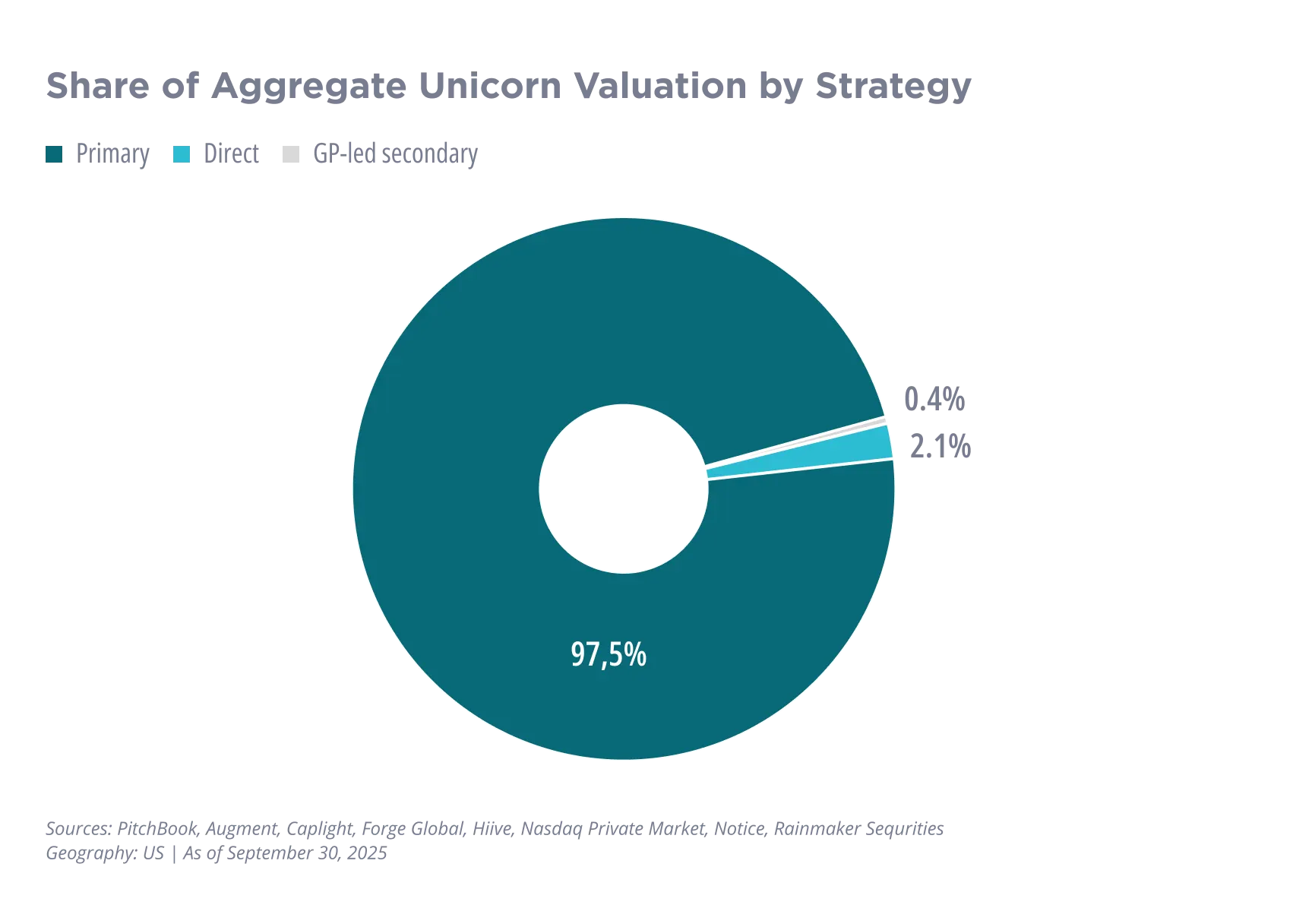
Primary rounds continue to dominate how unicorns are valued. With nearly all aggregate valuations set by the most recent fundraising event, secondary activity represents only a small fraction of total market value. Direct and GP-led transactions together account for just 2.5 percent, confirming that secondaries remain highly selective and are used more for targeted liquidity than for broad market price discovery.
This imbalance creates a unique opportunity. While primary rounds lock in headline valuations, secondaries allow investors to engage with leading private companies at market-driven pricing and with far greater flexibility. This is where Stableton is positioned. The Stableton Morningstar PitchBook Unicorn 20 operates within a system designed for institutional liquidity needs. As valuations reset and transparency improves, this becomes a key component of capturing long-term private market value.
THE UNTOLD UNICORN STORY
Neuralink: The neural border of technology and humanity
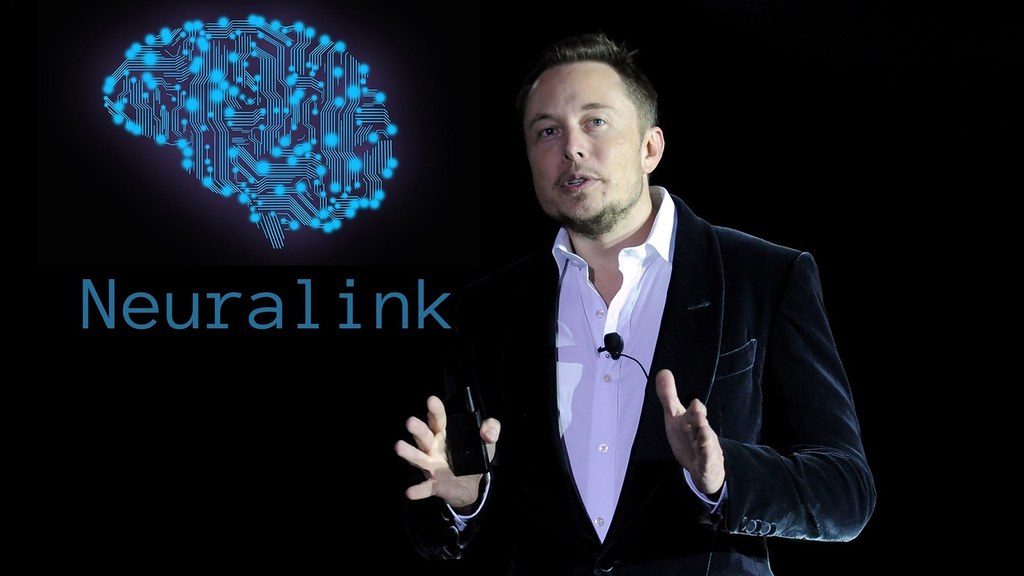
CEO & co-founder of Neuralink, Elon Musk. (27)
When Elon Musk and a small team of neuroscientists founded Neuralink in 2016, their goal was as ambitious as it was unprecedented: to create a high-bandwidth bridge between the human brain and computers. What began as a speculative research project has evolved into one of the world’s leading neurotechnology ventures. Neuralink’s brain-computer interface, a coin-sized implant designed to translate neural activity into digital signals, could one day restore movement and communication for people with paralysis.
While full commercialization remains several years away, Neuralink’s steady progress marks a major step toward integrating biotechnology and computing at the neural level. (28)
Fun Fact: The very first day Noland Arbaugh used his Neuralink device, he beat the 2017 world record for speed and precision in BCI cursor control. He's quadriplegic from a diving accident, and now uses the implant ~10 hours a day to study neuroscience, play Mario Kart, and build a speaking business. (29)
Did you know? Neuralink is one of the 20 companies in our Stableton Morningstar PitchBook Unicorn 20 strategy, a systematic, index-like approach that aims to outperform public benchmarks with low-cost fees, and without a performance fee. Click below for more information.
SOURCES
1 - Bloomberg, 2 - Business Inquirer, 3 - TechCrunch, 4 - Los Angeles Business Journal, 5 - Financial Times, 6 - The Information, 7 - TechCrunch, 8 - CNBC, 9 - Interesting Engineering, 10 - Decrypt, 11 - Reuters, 12 - Euronews, 13 - The Wall Street Journal, 14 - Financial Times, 15 - Snowflake, 16 - Bloomberg, 17 - Reuters, 18 - Financial Times, 19 - The Block, 20 - BBC, 21 - Reuters, 22 - TechCrunch, 23 - Reuters, 24 - Morocco World News, 25 - PR Newswire, 26 - Shield AI, 27 - Digital Watch Observatory, 28 - Reuters, 29 - Fortune


Every Wednesday, the Navigator delivers a digest of news from our portfolio holdings and key trends shaping private tech investing. Subscribe to receive it directly in your inbox.


