




Stripe’s $140B Tender Offer, OpenAI Tests Ads in ChatGPT, xAI’s $3B Chip Financing
By Stableton on February 11th, 2026
This week shows how private tech is being built and funded. A major Stripe tender, a multibillion-dollar Databricks raise, and large-scale xAI chip financing show how capital, liquidity, and infrastructure are shaping private tech today. Let's dive in…
THIS WEEK’S BREAKING NEWS
Stripe tender offer targets $140B valuation
Stripe is arranging a new tender offer valuing the company at $140B, up more than $30B from its last private valuation. The move extends Stripe’s use of secondary liquidity to support employees while remaining private, reinforcing management’s stance that an IPO is not imminent. The valuation reset follows profitability in 2024 and continued operational restructuring. (1)
MARKET UPDATE
Goldman forecasts $160B U.S. IPO rebound for 2026 after prolonged slowdown
Goldman Sachs strategists expect U.S. IPO proceeds to rebound to $160B in 2026, more than triple 2025 levels, driven by improved CEO confidence, supportive monetary policy, and steady economic growth. The outlook reflects normalization rather than exuberance, with ~120 listings projected. Risks include market volatility and heavy software exposure, while outcomes could range from $80B–$200B depending on large private issuers’ decisions. (2)
STABLETON MORNINGSTAR PITCHBOOK UNICORN 20 STRATEGY

The Stableton Morningstar PitchBook Unicorn 20 strategy is the world’s first passive, systematic, and semi-liquid approach to investing in the Top 20 privately held tech companies before they go public.
This strategy offers a straightforward and cost-effective way to gain exposure to leading private technology companies within a single portfolio. With no performance fees and enhanced liquidity, it offers a unique alternative to traditional private market investments.
PORTFOLIO NEWS
Anduril leads U.S. drone expansion into Indo-Pacific region
U.S. drone manufacturers are accelerating expansion into Asia as regional militaries respond to China’s build-up, leveraging battlefield validation from Ukraine and early Pentagon backing. At the Singapore Airshow, Anduril showcased loitering munitions and “loyal wingman” drones while securing regional sales, joined by peers pushing autonomy and production plans. (3)
Anduril extends CCA playbook to the U.S. Navy using YFQ-44 architecture
At the Singapore Air Show, Anduril signaled its intent to extend its Collaborative Combat Aircraft expertise to the U.S. Navy. Rather than adapting its Air Force YFQ-44 Fury directly, Anduril plans a Navy-specific platform leveraging shared avionics, software, and modular architectures, potentially accelerating development timelines as the Navy defines carrier-based operational requirements. (4)
Anthropic commits to ad-free AI model, rules out advertising in Claude
Anthropic argues that advertising is fundamentally incompatible with AI conversations, positioning Claude as an ad-free tool for deep work, sensitive discussions, and complex problem-solving. The company highlights risks of distorted incentives, subtle commercial steering, and engagement-driven optimization. Instead, Anthropic commits to subscription and enterprise revenue, reinvesting in model quality while supporting user-initiated commerce and integrations without third-party advertising influence. (5)
Anthropic's new AI tool rattles European data stocks
Anthropic’s launch of an AI tool for corporate legal departments triggered a sharp sell-off across European data, publishing, and software stocks, as investors reassessed margin durability and disintermediation risk. Shares in companies including Relx (-14%), Wolters Kluwer (-13%), London Stock Exchange Group (-13%), and Pearson (-8%) fell, reflecting concerns that AI-driven automation could structurally pressure incumbent data and workflow providers. (6)
Anthropic launches Opus 4.6, targets enterprise workflows
Anthropic launched Claude Opus 4.6, its first major model release of the year, deepening its positioning with enterprise users who account for roughly 80% of revenues. The model improves sustained task execution, coding, financial analysis, and large-codebase reliability, topping the Finance Agent benchmark. The launch reinforces investor concerns about AI-driven disruption across software and productivity platforms. (7)
Goldman deploys Anthropic AI across core operations for accounting automation
Goldman Sachs is co-developing autonomous AI agents with Anthropic to automate trade accounting, transaction reconciliation, and client onboarding. Using Claude-based agents embedded across workflows, Goldman aims to materially reduce processing time in complex, rules-driven functions. The initiative supports a broader multi-year AI-led reorganization while signaling potential disintermediation of third-party service providers. (8)
Canva embeds brand design into ChatGPT and Claude
Canva has integrated its Brand Kit directly into AI assistants, enabling on-brand visual creation inside ChatGPT and Claude. The update embeds Canva as the visual layer within AI workflows, allowing branded decks, posts, and assets to be generated and edited in-chat. With over 12 million designs already created via LLM integrations, Canva is positioning itself as core infrastructure for AI-driven productivity. (9)
Databricks raises $5B at $134B valuation, reinforcing pre-IPO scale
Databricks closed a $5B equity round plus $2B in new debt capacity at a $134B valuation, alongside $5.4B in annualized revenue growing 65% year over year and positive free cash flow. AI products now contribute $1.4B in annualized revenue. The scale, growth, and balance sheet flexibility reinforce Databricks’ readiness for a future IPO, while extending its lead over public peers. (10)
Deel launches $15M global seed selection funnel via tournament model
Deel has launched The Pitch, a $15M global startup tournament targeting seed-stage founders worldwide. The program will screen over 20,000 startups across seven regions, with a final selection rate of 0.05%. Up to 100 regional winners receive $50K each, while up to ten global finalists secure $1M to scale, backed by partners including J.P. Morgan and a16z. (11)
OpenAI cites renewed ChatGPT growth ahead of $100B raise
OpenAI CEO Sam Altman told employees that ChatGPT has reaccelerated to 10%+ monthly growth, with 800M weekly users, as the company prepares an updated chat model and advances ad testing. The update comes amid competitive pressure from Anthropic, while OpenAI markets momentum to investors as it closes in on a $100B funding round. (12)
OpenAI drops ‘io’ branding amid hardware lawsuit
OpenAI has abandoned the “io” name for its forthcoming AI hardware following a trademark dispute with audio startup iyO. Court filings confirm OpenAI will not use the branding and that its first device, developed after acquiring Jony Ive’s hardware startup for $6.5B, will not ship before February 2027, later than previously indicated. (13)
OpenAI begins ad testing inside ChatGPT
OpenAI has begun testing ads in ChatGPT for logged-in adult users on Free and Go tiers in the U.S., while Plus, Pro, Business, Enterprise, and Education remain ad-free. Ads are clearly labeled, separated from answers, and do not influence responses. OpenAI positions advertising as a funding mechanism to sustain free access, with privacy safeguards, user controls, and exclusions for sensitive topics. (14)
Perplexity launches multi-model research with Model Council
Perplexity has launched Model Council, a multi-model research feature that runs a single query across multiple frontier AI models and synthesizes their outputs into one answer. By highlighting areas of agreement and disagreement, the tool addresses task-specific model bias and blind spots. Model Council is available to Perplexity Max subscribers, targeting higher-stakes research and decision-making use cases. (15)
Revolut hits one million users, commits $400M to Australia
Revolut has reached 1 million users in Australia six years after market entry and plans to invest $400M locally over five years. The fintech reports $250M in FX fee savings for Australians since 2020, rapid transaction growth, and rising paid subscriptions, as it shifts from travel-focused use toward everyday domestic spending in an increasingly competitive neo-banking market. (16)
Revolut sidelines Wall Street in private liquidity push
Revolut is expanding its in-house corporate development team to run secondary share sales internally, reducing reliance on Wall Street banks after executing employee and investor liquidity events that supported a $75B valuation. By managing secondaries itself, Revolut tightens control over pricing and process while cutting fees, reflecting a broader shift among late-stage fintechs toward private-market liquidity as IPO windows remain constrained. (17)
Ripple secures EU-wide EMI license in Luxembourg
Ripple secured full Electronic Money Institution (EMI) authorization from Luxembourg’s regulator, expanding its regulatory footprint to 75+ global licenses and enabling EU-wide scaling of Ripple Payments. The approval follows recent UK licensing and supports institutional use cases across cross-border payments and treasury. Momentum extends beyond licensing, with Ripple advancing RLUSD-based settlement via its GTreasury acquisition and a strategic partnership with LMAX Group. (18)
SpaceX delays Mars to prioritize NASA moon mission
SpaceX has delayed its planned 2026 Mars mission, refocusing on a lunar landing for NASA targeted for March 2027. The shift follows pressure to support the Artemis program and coincides with SpaceX’s deepening push into space-based AI infrastructure after acquiring xAI. Management frames the moon as a prerequisite for longer-term Mars ambitions. (19)
Apollo nears $3B chip-financing deal for xAI
Apollo Global Management is nearing a $3B chip-financing deal tied to xAI following its merger with SpaceX. The structure would fund Nvidia chip purchases leased to xAI, easing heavy AI data-center cash burn. It marks Apollo’s second chip vehicle for xAI, underscoring growing private-credit involvement in AI infrastructure financing. (20)
OTHER NEWS
ByteDance video AI sparks rally in China app stocks
ByteDance’s launch of its Seedance 2.0 AI video model sparked a sharp rally in Chinese AI application and media stocks, with COL Group hitting its 20% daily limit and peers rising up to 10%. Analysts cited material gains in multimodal video generation quality, fueling expectations that IP owners and distribution platforms could benefit as China’s AI app momentum accelerates. (21)
Celonis taps Informatica veteran to lead North America and drive AI ROI
Celonis has appointed Ewan Henderson as General Manager for North America to lead go-to-market execution as enterprises seek measurable ROI from AI. With over 20 years in enterprise software, including senior roles at Informatica and Oracle, Henderson will focus on translating AI adoption into operational outcomes using Celonis’ Process Intelligence platform. (22)
Cerebras $23B funding round bolstered by Benchmark capital
VC powerhouse Benchmark Capital has committed ~$225M through special-purpose vehicles to deepen its stake in Cerebras Systems, part of a broader $1B financing that values the Nvidia competitor at ~$23B. The move underscores strong conviction in wafer-scale AI processors and institutional backing for diversified AI hardware infrastructure over the long term. (23)
Mistral launches ultra-fast, local AI translation models, challenges big labs with real-time translation
Mistral AI released Voxtral Mini Transcribe V2 and Voxtral Realtime, ultra-fast speech-to-text models translating 13 languages with sub-200ms latency. At 4B parameters, the models can run locally on phones or laptops, reducing cloud reliance and costs. Open-sourced and optimized for narrow tasks, Voxtral underscores Mistral’s strategy of efficient, sovereign AI as an alternative to US hyperscalers. (24)
Native USDC upgrade strengthens Polymarket infrastructure
Polymarket will replace bridged USDC.e on Polygon with native USDC through a partnership with Circle. The shift removes bridge risk across trading, settlement, and deposits, improving reliability and liquidity for the platform’s onchain markets. The move aligns with Circle’s strategy to deepen native USDC support on high-impact networks as Polymarket scales activity. (25)
CHART OF THE WEEK
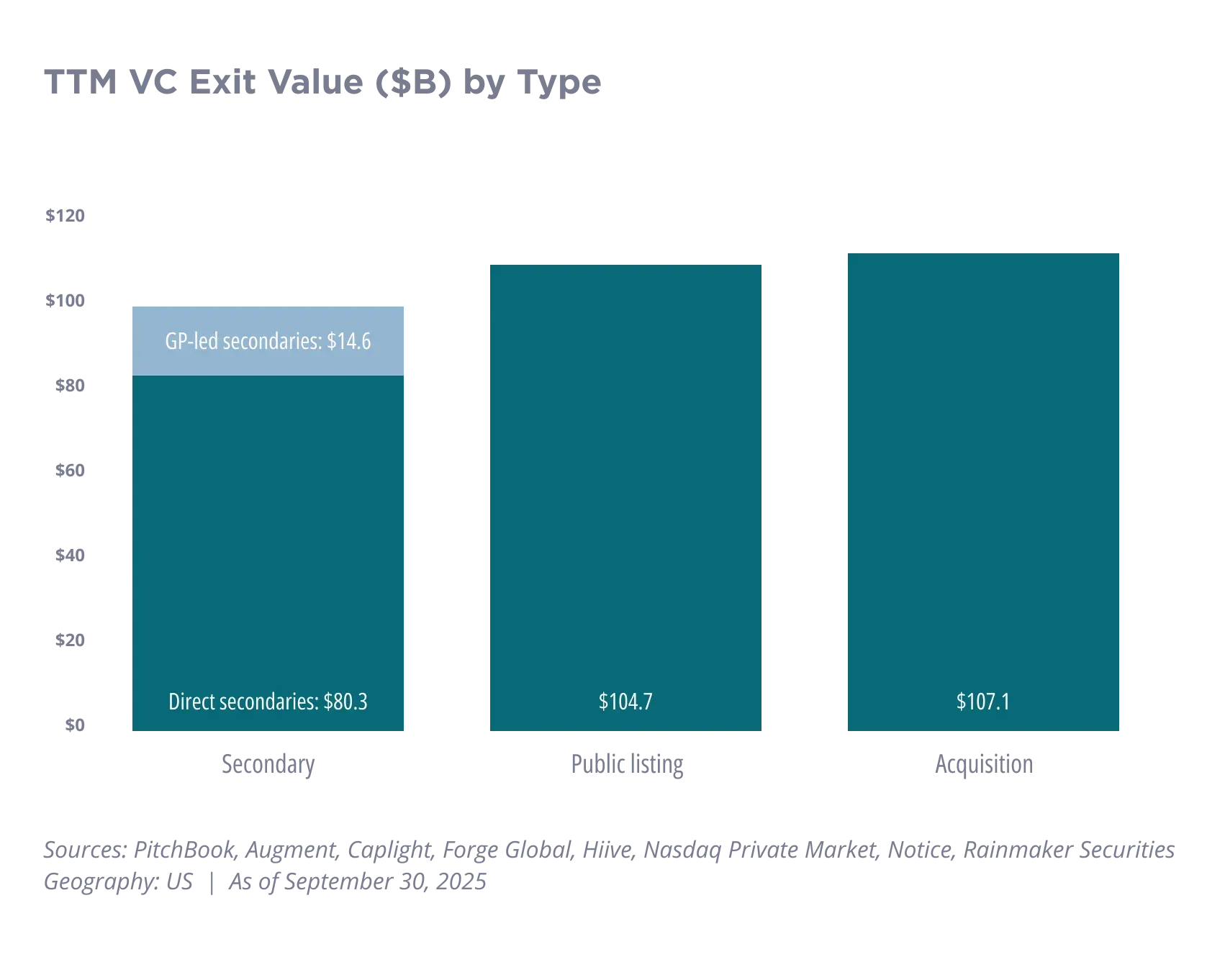
Secondaries have grown into a major liquidity engine for venture-backed companies. With more than $94B in transaction value over the past 12 months, direct and GP-led secondaries now sit almost shoulder to shoulder with IPOs and acquisitions. This near parity shows how the market has adapted as companies stay private longer and traditional exits remain uneven. For many late-stage unicorns, secondary transactions are no longer incidental. They are a strategic mechanism to release partial liquidity, manage shareholder expectations, and maintain momentum during the growth phase.
This shift creates a clearer and more flexible landscape for institutional investors, banks, wealth managers, and family offices. The Stableton Morningstar PitchBook Unicorn 20 is positioned directly in this environment, focusing on the private blue-chip tech leaders that consistently generate meaningful secondary activity. By combining systematic access with institutional liquidity terms, investors participate in late-stage value creation as secondaries continue to expand their role in the exit spectrum.
THE UNTOLD UNICORN STORY
OpenAI: Building intelligence, not just algorithms
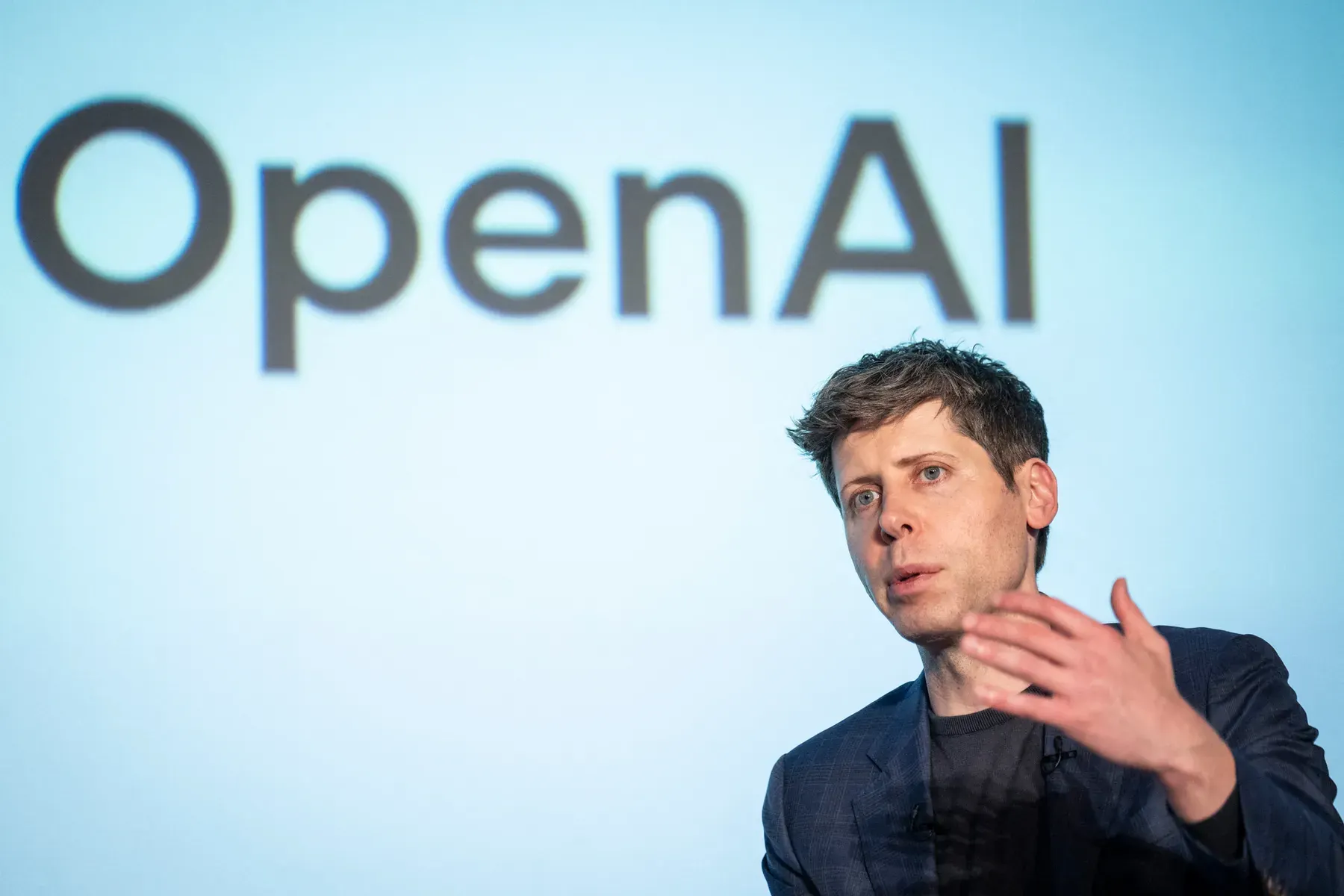
CEO of OpenAI, Sam Altman. (26)
Founded in 2015 in Silicon Valley, OpenAI began as a nonprofit research lab to develop Artificial General Intelligence (AGI) that benefits all of humanity. Led by Sam Altman, Elon Musk, Greg Brockman, and Ilya Sutskever, the team prioritized safety, transparency, and long-term research over short-term returns.
In 2019, OpenAI evolved into a capped-profit company, a structure that enables commercial scale while maintaining ethical constraints. This framework allowed it to raise capital competitively while ensuring excess profits are reinvested into the mission. Today, OpenAI’s models have redefined how humans create and communicate, driving adoption across industries and establishing the company as one of the world’s most valuable private tech firms. (27)
Fun Fact: ChatGPT gained one million users in five days and 100 million in two months, becoming the fastest-growing internet application in history. OpenAI engineers said they had not expected ChatGPT to be very successful and were surprised by the coverage it received. For comparison, it took Facebook 4.5 years, Instagram 2.5 years, and TikTok 9 months to reach 100 million users. (28)
Did you know? OpenAI is one of the 20 companies in our Stableton Morningstar PitchBook Unicorn 20 strategy, a systematic, index approach that aims to outperform public benchmarks with low-cost fees, and without a performance fee. Click below for more information.
SOURCES
1 - Bloomberg, 2 - Bloomberg, 3 - The Business Times, 4 - USNI News, 5 - Anthropic, 6 - The Guardian, 7 - CNBC, 8 - CNBC, 9 - Business Wire, 10 - CNBC, 11 - Business Wire, 12 - CNBC, 13 - WIRED, 14 - OpenAI, 15 - Perplexity AI, 16 - Finance Magnates, 17 - Bloomberg, 18 - Yahoo Finance, 19 - The Wall Street Journal, 20 - The Information, 21 - Bloomberg, 22 - Business Wire, 23 - TechCrunch, 24 - WIRED, 25 - The Block, 26 - Bloomberg, 27 - CNBC, 28 - Reuters



Every Wednesday, the Navigator delivers a digest of news from our portfolio holdings and key trends shaping private tech investing. Subscribe to receive it directly in your inbox.


