




SpaceX Files IPO, OpenAI Raises $122B at $852B Valuation, Anthropic Surpasses OpenAI Revenue
By Stableton on April 8th, 2026
Capital shifts, growth accelerates, and defense tech rises. SpaceX moves closer to IPO, OpenAI maintains AI expansion momentum, and Anthropic overtakes OpenAI on revenue for the first time. Let’s dive in…
THIS WEEK’S BREAKING NEWS
SpaceX files for record-setting IPO
SpaceX’s IPO filing points to a potential June listing at up to $1.75T and a capital raise reportedly as high as $75B, which would eclipse prior U.S. IPO records. The setup pairs unmatched scale, including $24.4B in federal contracts since 2008 and 165 orbital flights in 2025, with real execution risk if market volatility persists. (1)
STABLETON MORNINGSTAR PITCHBOOK UNICORN 20 STRATEGY

The Stableton Morningstar PitchBook Unicorn 20 strategy is the world’s first passive, systematic, and semi-liquid approach to investing in the Top 20 privately held tech companies before they go public.
This strategy offers a straightforward and cost-effective way to gain exposure to leading private technology companies within a single portfolio. With no performance fees and enhanced liquidity, it offers a unique alternative to traditional private market investments.
PORTFOLIO NEWS
Anduril and Impulse push orbital defense frontier in new partnership
Impulse Space is partnering with Anduril to develop space-based interceptor prototypes for the Pentagon’s Golden Dome missile defense system, a $185B initiative targeting operational capability by 2028. Early contracts remain below $9M, but successful prototypes could unlock larger awards. The project’s scale and technological complexity highlight execution risk despite increasing defense-tech collaboration. (2)
Anduril proves real-time NATO defense integration with cross-border data flow
Anduril recently showed rapid, cross-border defense integration during Digital Shield 2.0, linking Estonian and U.S. systems into a unified sensor-to-effector kill chain in under seven days. Using Lattice, over a dozen sensors and effectors were integrated across sovereign networks, enabling real-time threat detection and response, highlighting scalable interoperability across NATO’s fragmented defense infrastructure. (3)
Anduril lands $87M AI drone contract with Pentagon
Anduril secured an $87M Pentagon task order for its AI-driven Lattice counter-drone platform, within a procurement framework enabling up to $20B in purchases over ten years. The system integrates sensors and countermeasures to neutralize drones within seconds, reflecting a shift toward scalable, software-defined defense amid rising geopolitical tensions and sustained defense budget expansion. (4)
Anthropic overtakes OpenAI in revenue race
Anthropic reported a $30B revenue run-rate, nearly tripling from ~$9B at end-2025 and surpassing OpenAI’s ~$24B run-rate. Growth is driven by enterprise adoption, with 1,000+ customers spending over $1M annually. To support demand, Anthropic secured multi-gigawatt TPU capacity with Google and Broadcom, reinforcing compute as the core scaling constraint in AI. (5)
Anthropic partners with Australia on AI oversight
Anthropic will share its economic index data with the Australian government to track AI adoption, labor impact, and emerging risks, while collaborating on safety evaluations and academic research. The agreement also includes potential investments in data centers and energy infrastructure, aligning with Australia’s AI roadmap, which relies on existing laws and voluntary guidelines rather than dedicated regulation. (6)
Anthropic acquires Coefficient Bio to deepen healthcare AI
Anthropic acquired AI biotech startup Coefficient Bio for approximately $400M, integrating its team into its healthcare life sciences division. Coefficient Bio’s platform automates drug R&D, clinical strategy, and opportunity identification. The deal strengthens Anthropic’s vertical AI push, complementing partnerships with major pharma players and expanding its enterprise footprint in regulated industries like healthcare. (7)
Anthropic faces code leak amid rising competition
Anthropic disclosed a source code leak affecting its Claude Code assistant, attributed to a packaging error rather than a breach, with no customer data exposed. The incident follows another recent data exposure, raising operational concerns. Claude Code’s rapid adoption, reaching over $2.5B in run-rate revenue, underscores the competitive stakes as rivals intensify investment in AI coding tools. (8)
Cursor launches agent-first coding to challenge AI market rivals
Cursor launched Cursor 3, an agent-first coding interface designed to compete with Anthropic’s Claude Code and OpenAI’s Codex, as developer workflows shift toward autonomous agents. Despite strong growth and a reported $50B valuation, Cursor faces pricing pressure from subsidized rivals and rising capital intensity as AI labs scale vertically integrated offerings. (9)
Databricks integrates multi-agent drug discovery via AiChemy
Databricks introduced AiChemy, a multi-agent AI architecture that combines enterprise and external scientific data via MCP to accelerate drug discovery workflows, such as target identification and candidate evaluation. Built on its Data Intelligence Platform, Delta Lake, and Mosaic AI, the system orchestrates domain-specific agents and skills, enabling pharma teams to unify fragmented datasets and improve early-stage R&D efficiency. (10)
Wiliot partners with Databricks to power physical AI at scale
Wiliot connects with Databricks to run its Physical AI platform on Databricks’ lakehouse infrastructure, enabling enterprises to process real-time item-level data from battery-free IoT Pixels. The integration supports applications like automated inventory, shipment verification, and temperature monitoring, allowing organizations to unify physical and enterprise data for scalable, AI-driven supply chain automation. (11)
Figure AI showcases humanoid robotics with podcast show exposure
Figure AI showcased its Figure 03 humanoid on The Shawn Ryan Show, showing AI-driven locomotion, dexterity, and human-like interaction using neural-network control across ~40 joints. The robot lifts up to 40 pounds, runs 4–5 hours per charge, and is being piloted with partners like BMW. With production at one unit every 90 minutes, Figure signals early industrial scaling and deployment readiness. (12)
OpenAI closes $122B round at $852B valuation
OpenAI closed a $122B funding round at an $852B post-money valuation, up from the $110B commitment disclosed in February, with SoftBank, Andreessen Horowitz, and D. E. Shaw Ventures among participants. The company said ChatGPT now serves more than 900 million weekly active users, generates $2B in monthly revenue, and made $13.1B last year, but remains unprofitable as IPO expectations build. (13)
OpenAI urges AI-era overhaul of tax and labor policy
OpenAI’s new policy paper argues that advanced AI could force governments to rethink taxation, labor protections, and social support as automation reshapes work and concentrates economic gains. The document frames AI access as a foundational economic resource, proposes stronger oversight and worker safeguards, and lands as governance scrutiny around Sam Altman resurfaces after reports of past internal conflict over safety and transparency. (14)
OpenAI acquires TBPN in media expansion push
OpenAI is acquiring TBPN, an 11-person tech talk show business, in a deal valued in the low hundreds of millions, adding a media asset despite recent internal calls to avoid “side quests.” TBPN averages 70,000 viewers per daily episode and was on track for about $30M in annual revenue, while OpenAI says the team will support communications but remain editorially independent. (15)
Perplexity extends Computer with AI tax filing module
Perplexity has expanded Perplexity Computer with tax modules that can draft U.S. federal returns on IRS forms, review accountant-prepared filings, and build custom tracking tools for complex tax workflows. The system is grounded in IRS materials and updated for new laws and forms, with the company citing one test where it found a 67% understatement in overtime-related deductions on an attorney-prepared 2025 return. (16)
Ramp and Visa deepen ties to automate corporate expenditures
Ramp and Visa expanded their partnership through a renewed multi-year issuing agreement and deeper integration around Visa Intelligent Commerce and the Visa Trusted Agent Protocol. The move brings AI agents into corporate bill pay and spend management for Ramp’s 50,000+ customers, aiming to automate workflows, strengthen transaction-level controls, reduce manual work, and improve savings for large global organizations. (17)
Peru license advances Revolut LATAM expansion
Revolut secured an Organization License from Peru’s SBS, enabling it to establish a local banking entity and progress toward full regulatory approval. The move positions Revolut to become Peru’s first fully digital bank, reinforcing its Latin America expansion alongside Brazil, Mexico, Colombia, and Argentina. The company reported $6.0B revenue, $2.3B net profit, and $67B+ customer balances (+66%), highlighting strong operating leverage as it scales internationally. (18)
Ripple unifies fiat and crypto treasury workflows with Ripple Treasury
Ripple launched Digital Asset Accounts and Unified Treasury within Ripple Treasury, embedding native digital asset capabilities into enterprise treasury workflows for the first time. Built on its $1B GTreasury acquisition, the platform enables real-time unified visibility across fiat and digital liquidity. With $13T processed in 2025 and 72% of CFOs seeking digital asset integration, the launch addresses a key institutional adoption bottleneck. (19)
Mega IPO bank syndicates signal SpaceX $1.75T ambitions
SpaceX is preparing a June IPO, codenamed Project Apex, with a $1.75T expected valuation and a 21-bank underwriting syndicate—one of the largest in recent years. Lead bookrunners include Morgan Stanley, Goldman Sachs, and JPMorgan Chase. The broad syndicate structure reflects the scale, global distribution complexity, and anticipated demand across institutional and wealth channels. (20)
Stripe hedges across competing AI payment standards
Stripe is strategically positioning itself across both emerging AI payment standards, backing its Machine Payments Protocol (MPP) with Paradigm while also integrating x402 alongside Coinbase and Cloudflare. x402, now under the Linux Foundation, has processed ~97M transactions, while MPP targets session-based micropayments. With $33T stablecoin volume and rising institutional backing, Stripe is effectively hedging for control of AI-native financial rails. (21)
OTHER NEWS
ByteDance backs OpenClaw in China AI agent race
ByteDance is supporting OpenClaw’s China expansion by providing cloud infrastructure for a localized ClawHub marketplace distributing “skills” that extend AI agent functionality. The move intensifies competition with Tencent, which launched a rival SkillHub and later sought rapprochement after criticism. The dynamic underscores how control over AI agent ecosystems and developer distribution is emerging as a key competitive layer in China. (22)
Mistral finances sovereign AI infrastructure across Europe
Mistral raised $830M in debut debt financing to build Nvidia-powered data centers across Europe, targeting sovereign AI demand as governments and enterprises seek alternatives to US hyperscalers. Backed by banks including BNP Paribas and HSBC, the company plans 200MW capacity by 2027. With a €12B valuation and approaching $1B ARR, Mistral is scaling a full-stack European AI infrastructure strategy. (23)
Alloy and Plaid target AI-driven fraud surge
Alloy partnered with Plaid to integrate network-level fraud intelligence into onboarding and lifecycle risk workflows as AI-driven fraud rises (+9.2% in losses). With only 24% of institutions detecting fraud at onboarding, the collaboration enables layered, data-rich identity verification and automated KYC/KYB/AML processes, allowing institutions to dynamically test and deploy risk strategies at scale. (24)
Polymarket faces backlash over war-related betting
Polymarket removed a betting market tied to a U.S. military rescue mission in Iran following political backlash, highlighting rising scrutiny of prediction markets. Lawmakers, including Seth Moulton, are calling for stricter oversight, with proposed legislation targeting bets on war, elections, and government actions. The episode underscores increasing regulatory pressure and reputational risks as platform usage expands. (25)
CHART OF THE WEEK
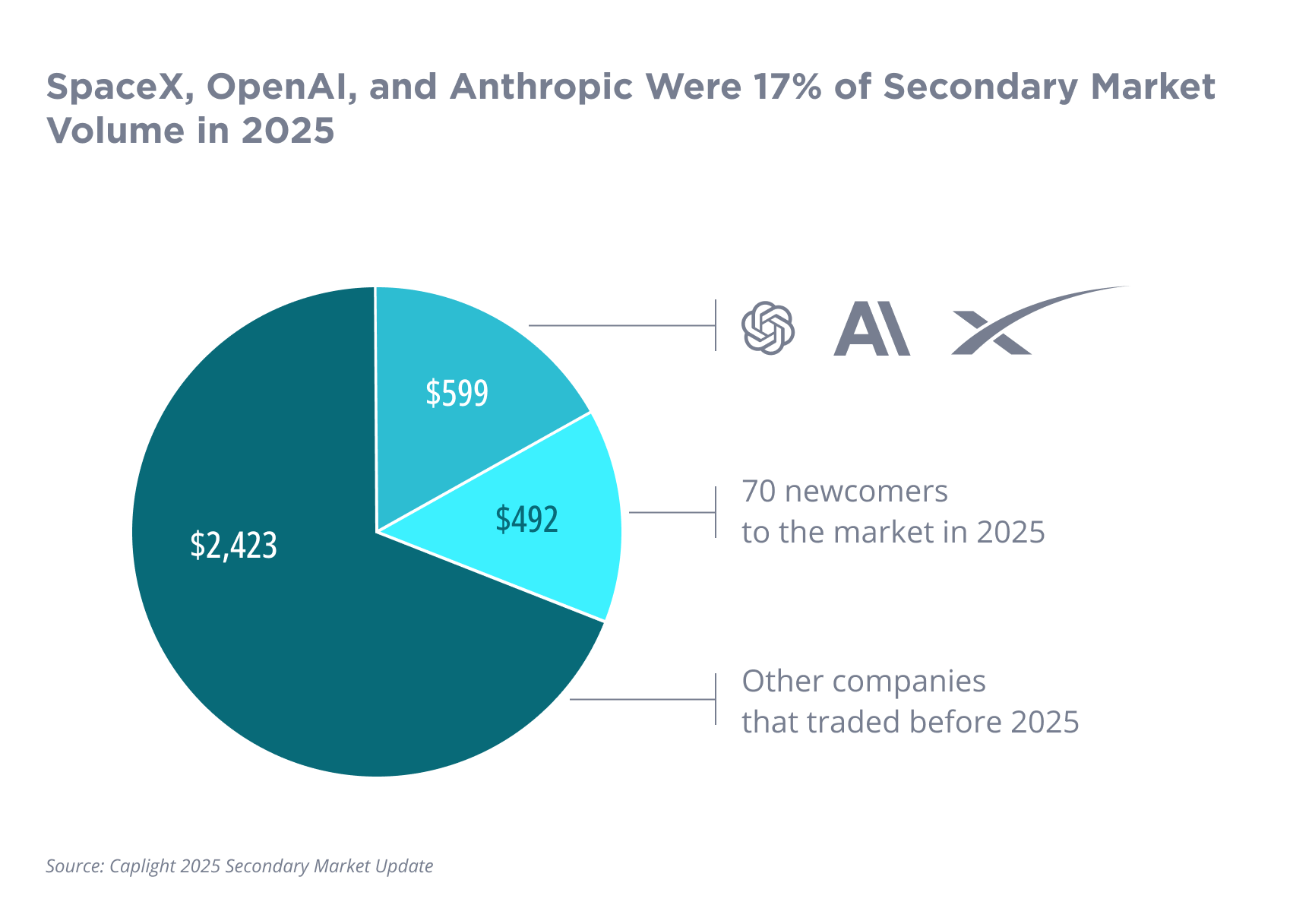
Secondary market volume in 2025 was heavily influenced by a small group of dominant names. SpaceX, OpenAI, and Anthropic alone accounted for a meaningful share of trading activity, reflecting their scale, visibility, and proximity to potential IPOs. With combined valuations representing a significant portion of the pre-IPO universe, these companies naturally attract the deepest pools of capital and the most consistent secondary demand. As they move closer to public markets, they continue to act as liquidity magnets, anchoring pricing and activity across the ecosystem.
At the same time, the data points to the next phase of market rotation. As established private tech leaders prepare for listings, new companies are beginning to fill the liquidity gap. This pipeline suggests that secondary markets are broadening beneath the surface, even as capital remains selective. The Stableton Morningstar PitchBook Unicorn 20 strategy is positioned to navigate both dynamics, maintaining exposure to core leaders while selectively engaging with the next generation of private market entrants as liquidity expands.
THE UNTOLD UNICORN STORY
Epic Games: Basement business turned gaming empire
 Epic Games CEO Tim Sweeney. (26)
In 1989, Tim Sweeney was a college freshman who hated the text editors that came with his programming tools, so he started building his own. Then he turned the cursor into a smiley face. Then he added walls, enemies, bullets, and puzzles. By 1991, that side project had become ZZT, a shareware game he sold for $100 a day out of his parents' basement, with his father fulfilling mail orders. ZZT shipped with something radical: a free built-in editor that let anyone create their own games, a philosophy that would later define the Unreal Engine. (27)
Sweeney dropped out of college one credit shy of a degree to go all-in on games, renaming his one-man operation "Epic MegaGames" because it sounded more impressive. Three decades later, Fortnite has over 650 million registered accounts, and the Unreal Engine powers everything from blockbuster games to The Mandalorian's virtual sets. (28)
Fun Fact: When Sweeney renamed his company to "Epic MegaGames" in 1992, he later admitted it was "kind of a scam to make it look like we were a big company." In reality, he was the only employee, working out of his parents' house. When Epic finally became a real big company, they dropped the "Mega" in 1999. (29)
Did you know? Epic Games is one of the 20 companies in our Stableton Morningstar PitchBook Unicorn 20 strategy, a systematic, index approach that aims to outperform public benchmarks with low-cost fees, and without a performance fee. Click below for more information.
SOURCES
1 - CNBC, 2 - Bloomberg, 3 - Anduril, 4 - MSN, 5 - Neowin, 6 - Reuters, 7 - The Information, 8 - CNBC, 9 - WIRED, 10 - InfoWorld, 11 - IOT News, 12 - Interesting Engineering, 13 - CNBC, 14 - Decrypt, 15 - Financial Times, 16 - Neowin, 17 - PR Newswire, 18 - FX News Group, 19 - Fintech Weekly, 20 - CNBC, 21 - Bloomberg, 22 - The Information, 23- Financial Times, 24 - PR Newswire, 25 - CNBC, 26 - The Information, 27 - MatthewBall.Co, 28 - Yahoo Finance, 29 - Game Developer



Every Wednesday, the Navigator delivers a digest of news from our portfolio holdings and key trends shaping private tech investing. Subscribe to receive it directly in your inbox.


