




Amazon Commits $25B to Anthropic, Cursor Targets $50B Valuation, Kraken Gets $200M Backing From Deutsche Börse
By Stableton on April 22nd, 2026
Capital is flowing into compute, coding, and crypto. Anthropic secures the compute to compete, Cursor pushes the next leg of AI infrastructure, and Kraken draws traditional capital deeper into crypto markets. Let’s dive in…
THIS WEEK’S BREAKING NEWS
Anthropic locks $25B compute commitment from Amazon
Amazon is expanding its partnership with Anthropic through an additional $5B investment, with total commitments potentially reaching $25B, tied to commercial milestones. Anthropic will commit over $100B to AWS and secure up to 5 gigawatts of compute, addressing infrastructure bottlenecks as revenue run-rate hits $30B and demand for Claude accelerates amid pre-IPO positioning. (1)
MARKET UPDATE
HK IPO market rebounds with $14B raised
Hong Kong’s IPO market is rebounding sharply in 2026, with 40 listings raising $14 billion year-to-date, led by hard tech and new economy sectors. Strong post-listing performance and a pipeline of ~400 applications signal sustained momentum, supported by capital inflows, A-to-H listings, and Hong Kong’s positioning as a stable gateway for Chinese tech firms accessing global markets. (2)
STABLETON MORNINGSTAR PITCHBOOK UNICORN 20 STRATEGY

The Stableton Morningstar PitchBook Unicorn 20 strategy is the world’s first passive, systematic, and semi-liquid approach to investing in the Top 20 privately held tech companies before they go public.
This strategy offers a straightforward and cost-effective way to gain exposure to leading private technology companies within a single portfolio. With no performance fees and enhanced liquidity, it offers a unique alternative to traditional private market investments.
PORTFOLIO NEWS
U.S Air Force tests pilotless Anduril combat drone
The U.S. Air Force advanced its Collaborative Combat Aircraft program through hands-on sorties with Anduril’s YFQ-44A, a semiautonomous jet drone operated without traditional pilot controls. Testing validated rapid deployment, minimal crew maintenance, and mission control via ruggedized laptops, eliminating fixed infrastructure. With a target fleet of 1,000 CCAs, the program emphasizes operator-led experimentation to accelerate acquisition cycles and operational readiness decisions. (3)
Anthropic tests limits of global cyber defenses with Mythos model
Anthropic’s Mythos model highlights a growing asymmetry in cybersecurity, identifying and exploiting vulnerabilities faster than organizations can respond. AI-driven attacks rose 89% in 2025, with breach activation times dropping to 29 minutes. Governments and banks are reacting urgently, as the model’s ability to automate large-scale exploitation underscores systemic risk across financial and critical infrastructure. (4)
Claude Opus 4.7 limits cyber capabilities for safer rollout
Anthropic launched Claude Opus 4.7 as its most powerful broadly available model, prioritizing software engineering, reasoning, and real-world task execution while deliberately limiting cyber capabilities relative to Mythos. Deployed with automated safeguards to block high-risk use cases, the model reflects Anthropic’s strategy to balance performance with controllability as it tests pathways toward scaling more advanced, higher-risk systems. (5)
Northrop Grumman’s defense autonomy evolve with Applied Intuition integration
Applied Intuition played a central role in Northrop Grumman’s Talon IQ test, where its mission autonomy software was seamlessly activated mid-flight, replacing Prism and later transitioning to Accelint without operational disruption. The demonstration underscores Applied Intuition’s positioning as a critical enabler of modular, interoperable defense autonomy, supporting real-time mission execution across evolving multi-system architectures. (6)
Canva pushes toward fully agentic creative infrastructure with 2.0 update
Canva’s AI 2.0 update introduces a unified conversational interface that orchestrates its full design suite, enabling prompt-based creation of multi-channel campaigns and content workflows. Positioned as its largest product shift since moving design to the browser, the update reflects a broader transition toward agentic, end-to-end creative platforms, intensifying competition with Adobe in AI-driven content production. (7)
Anthropic and Canva connect AI output to workflows
Canva and Anthropic expanded their partnership, integrating Canva into Claude Design to convert AI-generated drafts into fully editable, collaborative outputs. New HTML import and artifact editing capabilities bridge code-based generation with design workflows. With 250M+ monthly users and 27B+ AI interactions, Canva is positioning itself as the execution layer for AI-generated content at scale. (8)
Cursor targets $50B valuation in AI coding race with $2B raise
Cursor is in advanced discussions to raise $2B at a valuation exceeding $50B, with Andreessen Horowitz expected to co-lead and Nvidia among potential participants. The round reflects accelerating demand for AI-driven coding tools, positioning Cursor at the center of the vibe coding shift as competition intensifies with frontier model providers. (9)
Databricks appoints APJ head amid enterprise demand surges
Databricks appointed Simon Davies to lead APJ as regional growth exceeded 85% year-on-year, driven by enterprises shifting from AI experimentation to production deployment. With 1,500+ employees and a new Singapore HQ, Databricks is scaling execution across financial services, telecom, and public sector clients as demand for unified data and AI platforms accelerates. (10)
Databricks target agent sprawl with governance tools
Databricks, together with Salesforce, introduced governance features for agentic AI, addressing rising enterprise concerns around “agent sprawl,” security, and cost control. Integrated into Agent Fabric and AI Gateway, the tools enable granular permissions, API governance, and cost tracking. The launches follow Amazon Web Services’ Agent Registry, signaling a broader industry shift toward centralized control layers for scaling AI agents. (11)
Deutsche Börse backs Kraken with $200M at $13.3B valuation
Deutsche Börse agreed to acquire a 1.5% stake in Kraken for $200M, valuing the company at $13.3B, down from $20B previously. The move reflects accelerating institutional entry into crypto via minority stakes and partnerships, particularly around tokenized assets, as traditional players seek faster market access and credibility without building in-house infrastructure. (12)
OpenAI launches GPT-5.4 model amid AI risk concerns
OpenAI launched GPT-5.4-Cyber to a restricted group of vetted users, targeting autonomous detection of software vulnerabilities amid rising systemic cyber risk. The release follows Anthropic’s Mythos model and reflects escalating competition in AI-driven security, with prior OpenAI tools already identifying over 3,000 critical vulnerabilities as governments and banks assess potential infrastructure exposure. (13)
Novo Nordisk partners with OpenAI to accelerate drug discovery
Novo Nordisk partnered with OpenAI to integrate AI across drug discovery, manufacturing, and commercial operations, with pilots underway and full rollout targeted by 2026. The collaboration aims to accelerate identification of drug candidates and improve operational efficiency, leveraging large-scale data analysis to shorten development cycles and enhance productivity across the pharmaceutical value chain. (14)
Perplexity launches Mac AI assistant for autonomous workflows
Perplexity AI launched Personal Computer for Mac, extending its multi-model orchestration into agentic workflows that operate across files, apps, and web environments. The system enables autonomous task execution, including managing to-do lists and organizing data, within a secure, auditable sandbox. The release positions Perplexity within the emerging category of AI operating layers competing to control end-user productivity workflows. (15)
Ramp launches multichain wallet to simplify self-custody
Ramp Network launched a multichain self-custodial wallet integrating buying, selling, swapping, and cash-out within a single application, eliminating reliance on third-party providers. Supporting ETH across eight networks at launch, the product targets crypto’s fragmented user experience while maintaining asset control. With 10M+ users and MiCA authorization, Ramp is positioning itself as a unified infrastructure layer for streamlined self-custody flows. (16)
Revolut delays IPO, leans on secondary liquidity
Nikolay Storonsky signaled an IPO timeline of at least 2028, prioritizing trust and continued private market scaling. The company is leveraging recurring secondary sales, including a recent $75B valuation, to provide liquidity while expanding globally, notably pursuing a US banking license to deepen its regulated footprint ahead of public listing. (17)
Ripple moves to secure XRPL amidst risks; targets ledger by 2028
Ripple outlined a roadmap to make the XRP Ledger quantum-resistant by 2028, citing a shift from theoretical to credible cryptographic risk. The plan addresses threats like “harvest now, decrypt later,” using features such as native key rotation. The move positions XRPL ahead of peers like Ethereum in preparing long-duration digital assets for post-quantum security transitions. (18)
Visa, Stripe build validator network for real-time payments
Visa joined Stripe’s Tempo blockchain as an anchor validator, alongside Zodia Custody by Standard Chartered, marking a significant step in institutional adoption of blockchain-based payments. The network, designed for real-time and agentic commerce, leverages participants processing trillions in annual volume, positioning Tempo as enterprise-grade infrastructure for stablecoin and AI-driven payment flows. (19)
xAI rents compute to Cursor amid $13B capex
xAI will supply tens of thousands of chips to Cursor under a compute rental agreement to train advanced coding models. The deal helps offset xAI’s heavy capital expenditures, which reached $13B against $3.2B in revenue, following its integration with SpaceX, which reported nearly $5B in losses in 2025. (20)
OTHER NEWS
British Investor builds $500M ByteDance stake at $600B
A London-based investor, Fred Blackford of Future Positive Global, has built a $500M secondary-market stake in ByteDance, betting on a valuation disconnect as the company approaches $600B, up from under $300B. The move capitalizes on geopolitical-driven sell-offs and restricted US capital flows, positioning ByteDance as a discounted global AI and consumer platform despite ongoing IPO uncertainty. (21)
Celonis powers Molex supply chain AI transformation
Celonis enabled Molex to transform its global supply chain using process intelligence, creating a digital twin to support enterprise AI deployment. Outcomes include purchase order confirmation rates rising from 30% to 90%, 87% touchless invoices, and 10–15% warehouse efficiency gains. The case highlights process data as a prerequisite for scaling AI beyond fragmented, siloed systems. (22)
Cerebras files IPO backed by $20B OpenAI deal
Cerebras filed for a Nasdaq IPO after reporting $510M in 2025 revenue (+76%) and $87.9 million net income, reversing a prior loss. With $24.6 billion in contracted backlog and a $20B-plus compute deal with OpenAI, the company is shifting toward cloud-based AI infrastructure, positioning itself as a scaled alternative to GPU incumbents. (23)
Polymarket scales to $15B amid trading surge; to raise $400M
Polymarket is in talks to raise $400M at up to a $15B valuation, driven by surging trading volumes exceeding $1B weekly amid heightened geopolitical activity. Backed by investors including Intercontinental Exchange, the platform is increasingly used for sentiment signals, though concerns around insider trading and market manipulation risks persist. (24)
Shield AI competes for $800M Navy ISR contract
Shield AI has been selected by the U.S. Navy to compete for up to $800M in ISR service contracts, deploying its V-BAT VTOL drone for persistent intelligence and surveillance missions. The contractor-owned model underscores a shift toward scalable, service-based defense procurement, leveraging proven operational performance in contested environments to support modern naval and joint force requirements. (25)
CHART OF THE WEEK
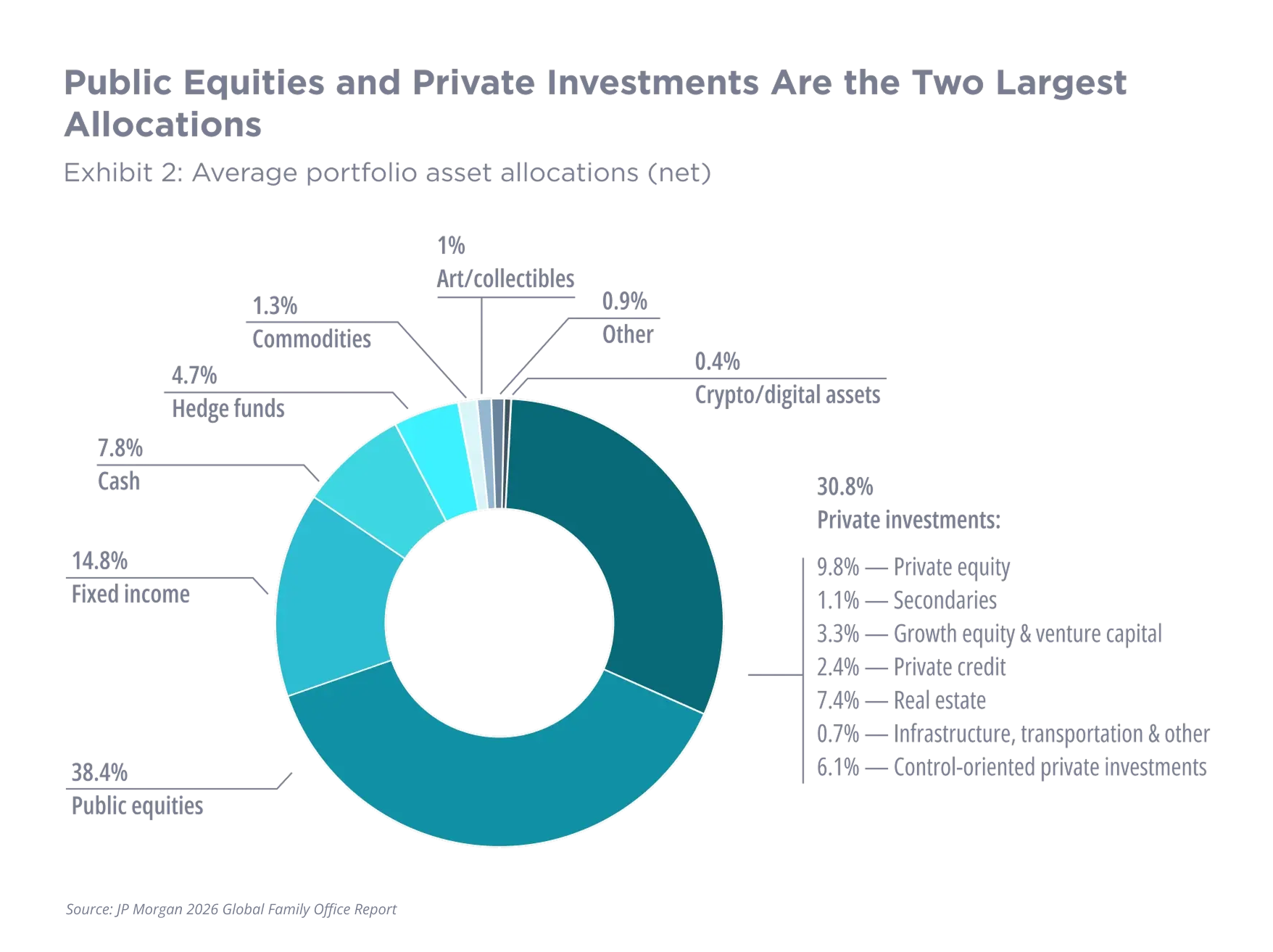
Family office portfolios are undergoing a reweighting. Private investments now sit alongside public equities as a core allocation rather than a peripheral one. This shift reflects more than a search for yield. Family offices are deliberately positioning capital toward areas where innovation is created, control is retained, and return drivers are less dependent on public market cycles. Private equity, growth capital, private credit, and real assets are absorbing a growing share of portfolios as family offices prioritize durability, diversification, and long-term value creation.
This evolution also changes how capital partners are chosen. Family offices are increasingly acting as strategic investors, capable of committing flexibly and engaging across cycles. The Stableton Morningstar PitchBook Unicorn 20 strategy is aligned with this mindset, focusing on private blue-chip technology leaders where innovation, scale, and liquidity management intersect. As alternatives become foundational, disciplined exposure to the most valuable private companies becomes a defining component of long-term portfolio strategy.
THE UNTOLD UNICORN STORY
Figure AI: Creating the future of human-robot collaboration
 Brett Adcock, Founder & CEO of Figure AI. (26)
Figure AI is redefining the future of work through humanoid robotics. Founded in 2022, the company’s mission is to build general-purpose robots that can think, move, and assist in the real world.
At the heart of Figure’s progress is Helix, an AI system that combines vision, language, and action. It allows robots to interpret complex commands, understand their surroundings, and operate safely alongside people. Backed by partners such as OpenAI, Microsoft, NVIDIA, and BMW, Figure is rapidly advancing from research to large-scale deployment. Their vision is ambitious: create machines that complement human labor, performing useful tasks across industries from manufacturing to logistics. (27)
Fun Fact: Figure 01 learned to make coffee by watching just 10 hours of video footage of humans doing it. In a demonstration at Figure's San Francisco headquarters, when asked to make coffee, the robot responded autonomously operated a Keurig machine, all while self-correcting its own mistakes in real time.
Did you know? Figure AI is one of the 20 companies in our Stableton Morningstar PitchBook Unicorn 20 strategy, a systematic, index approach that aims to outperform public benchmarks with low-cost fees, and without a performance fee. Click below for more information.
SOURCES
1 - CNBC, 2 - Global Times, 3 - Defense News, 4 - Financial Times, 5 - CNBC, 6 - Northrup Grumman, 7 - The Verge, 8 - Business Wire, 9 - Bloomberg, 10 - CRN Asia, 11 - CIO Dive, 12 - Decrypt, 13 - Reuters, 14 - The Wall Street Journal, 15 - Engadget, 16 - Bitget, 17 - Bloomberg, 18 - The Block, 19 - Decrypt, 20 - The Information, 21 - Financial Times, 22 - Business Wire, 23 - CNBC, 24 - The Guardian, 25 - Shield AI, 26 - AP News, 27 - CNBC


Every Wednesday, the Navigator delivers a digest of news from our portfolio holdings and key trends shaping private tech investing. Subscribe to receive it directly in your inbox.


