




SpaceX Targets $75B IPO Raise, OpenAI Ads Hit $100M Run Rate, Anduril and Palantir Power $185B Defense System
By Stableton on April 1st, 2026
Bigger IPOs, new revenue layers, and software-led defense. SpaceX is testing IPO limits, OpenAI is scaling ads fast, and Anduril and Palantir are shaping military infrastructure. Let’s dive in…
THIS WEEK’S BREAKING NEWS
SpaceX plans largest IPO with $75B target
SpaceX is targeting a ~$75B IPO raise at a ~$1.75T valuation, potentially making it the largest listing in history, though plans remain unfiled and subject to change. The company may float less than 5% of equity and is exploring flexible lock-up structures, signaling evolving IPO mechanics as markets adapt to mega-cap private tech listings. (1)
PORTFOLIO NEWS
Anduril and Palantir lead Golden Dome software stack
Anduril and Palantir are developing the command-and-control software for the $185B Golden Dome missile defense system, acting as prime contractors over traditional defense players. The system integrates sensors, radars, and interceptors into a unified “glue layer,” highlighting the growing role of software in defense procurement and long-term contract value creation. (2)
Anthropic lawsuit opens debate on AI weapons regulation
Anthropic’s legal battle against the Pentagon over its supply chain risk designation could shape AI regulation, as a U.S. judge suggested the move may be an attempt to cripple the company. The case, backed by industry players, raises broader questions around AI use in weapons, governance gaps, and the balance between innovation and oversight. (3)
Judge blocks Pentagon’s Anthropic supply chain designation
Anthropic secured a preliminary injunction blocking the Pentagon’s “supply chain risk” designation, with a federal judge calling the move likely unlawful and arbitrary. The ruling restores Anthropic’s ability to operate without reputational restrictions, supporting its commercial standing, though government agencies may still limit usage through other channels pending further legal decisions. (4)
Anthropic’s new model signals leap in AI capabilities
Anthropic is testing a new model (“Claude Mythos/Capybara”) described as a step change in capability, particularly in reasoning, coding, and cybersecurity. The model surfaced via an accidental data leak, highlighting both rapid progress and rising risks, with early access limited as the company assesses potential misuse and prepares a cautious rollout. (5)
LG Innotek builds physical AI solutions with Applied Intuition
LG Innotek partnered with Applied Intuition to integrate sensing hardware with autonomy software, expanding into drones and robotics. Leveraging real-world validation and virtual sensor simulation, the collaboration aims to accelerate development cycles and increase adoption by global automakers, positioning both firms to capture value in the emerging physical AI stack. (6)
Canva enters outdoor advertising with Doohly acquisition
Canva acquired DOOH platform Doohly for ~$30M, expanding into outdoor advertising and extending its control across the marketing lifecycle. With operations across the UK, Australia, and New Zealand, the deal enables end-to-end campaign execution from design to physical deployment, reinforcing Canva’s platform strategy as it scales toward IPO readiness and $4B+ annualized revenue. (7)
Cursor CEO warns against fragile AI-driven coding practices
Michael Truell warned that “vibe coding,” relying fully on AI without understanding code, creates fragile systems that fail at scale. While AI accelerates development, Cursor emphasizes integrating AI within developer workflows to maintain control. With 1M+ daily users and ~$1B ARR, the company positions itself for enterprise-grade coding reliability. (8)
Databricks builds AI security stack through acquisitions
Databricks acquired startups Antimatter and SiftD.ai to underpin its new AI-driven security product, Lakewatch, following its $5B capital raise. The platform combines SIEM capabilities with AI agents powered by Anthropic, enabling threat detection and secure agent deployment, signaling Databricks’ push to integrate security into its core data and AI infrastructure stack. (9)
Databricks partnership brings physics-informed AI to energy
Applied Computing announced a strategic partnership with Wipro and Databricks to deploy its physics-informed AI platform, Orbital, across energy operators in the Middle East, India, and Southeast Asia. The collaboration targets real-world deployment—moving beyond pilots—by embedding explainable AI into operations. Notably, traditional models use under 10% of operational data, whereas this approach leverages multimodal datasets to improve efficiency, reduce emissions, and enable auditable, real-time decision-making. (10)
Databricks commits $850M to scale enterprise AI adoption
Databricks announced an $850 million investment in the UK over three years, expanding its London footprint into a 137,000 sq ft EMEA hub and doubling headcount to over 1,000. The initiative targets surging enterprise AI demand—where over 50% of FTSE 100 firms are already customers—and includes training 100,000 individuals while scaling adoption of AI-native products like Lakebase and Genie. (11)
Epic Games reduces workforce as Fortnite growth weakens
Epic Games will cut over 1,000 jobs as engagement declines for Fortnite, reflecting broader slowdown across the gaming sector. The company aims to stabilize operations with $500M+ in cost savings, highlighting pressure on live-service models as user growth stalls and content-driven engagement becomes harder to sustain in a weaker macro environment. (12)
Figure AI showcases humanoid robot for education at White House
Figure AI’s Figure 03 humanoid robot appeared at a White House summit alongside Melania Trump, highlighting growing policy-level interest in AI-driven education. Powered by a vision-language-action model, the robot demonstrates autonomous task execution and potential as a teaching assistant, while signaling broader momentum for humanoid robotics amid rising investment and institutional attention. (13)
OpenAI launches bug bounty for AI safety risks
OpenAI launched a Safety Bug Bounty program targeting AI-specific risks such as agentic misuse, prompt injection, and data exfiltration. Complementing its existing security program, the initiative incentivizes researchers to identify real-world abuse scenarios beyond traditional vulnerabilities, signaling a shift toward proactive governance as AI systems scale and interact more autonomously with users and external environments. (14)
OpenAI cuts Sora as IPO focus sharpens
OpenAI is shutting down its Sora video product and API as part of a strategic refocus ahead of a potential IPO, reallocating resources toward a unified AI super assistant and enterprise coding tools like Codex, which surpassed $1B ARR. The move reflects tightening priorities amid rising compute constraints, competitive pressure, and the need to consolidate monetization pathways. (15)
OpenAI aims to secure $120B in record funding round
OpenAI is in the process of raising an additional $10B to bring its funding round to over $120B, with commitments from investors including Microsoft and Andreessen Horowitz. With ~900M users and ~$13.1B revenue, the company is aligning capital, compute spending, and product focus as it prepares for a potential IPO. (16)
OpenAI ads pilot surpasses $100M annualized revenue
OpenAI’s ads pilot has surpassed $100M annualized revenue within two months of launch, with over 600 advertisers participating. Rolled out conservatively to a subset of free and Go users, the program introduces a scalable monetization layer without impacting trust metrics, signaling early traction in converting its large user base into advertising-driven revenue. (17)
Samsung and Perplexity bring agentic AI into appliances
Samsung has partnered with Perplexity AI to upgrade its Bixby assistant across its 2026 home appliance lineup, embedding large language models to enable contextual, multi-step voice interactions. The system moves beyond command-based inputs, leveraging prior user context and open Q&A capabilities to automate household tasks and deliver real-time responses, signaling a shift toward agentic, AI-native consumer ecosystems. (18)
Revolut scales India hub to support global growth
Revolut plans to base ~40% of its global workforce in India by 2026, scaling its headcount to 5,500 as part of a £500M investment in its global capability center. With ~12,000 employees globally, India is becoming central to product, operations, and AI-driven functions, highlighting a shift from cost outsourcing to strategic talent hubs supporting global fintech scaling. (19)
Ripple pilots stablecoin trade settlement with Singapore regulator
Ripple is piloting its RLUSD stablecoin in Monetary Authority of Singapore’s BLOOM sandbox with Unloq to automate cross-border trade finance. Payments are triggered upon shipment verification, replacing manual processes. The initiative strengthens RLUSD’s positioning as a regulated, programmable settlement asset for institutional use, advancing Ripple’s enterprise infrastructure strategy. (20)
Space stocks rally on SpaceX IPO expectations
SpaceX’s potential IPO filing, targeting a ~$75B raise at a ~$1.75T valuation, triggered a rally across listed space companies. Shares of Rocket Lab and Firefly Aerospace rose over 10%, reflecting how anticipation of a flagship listing is already repricing the broader space sector and investor expectations for the category. (21)
Branch integrates with Stripe for instant worker payouts
Branch integrated with Stripe to offer embedded digital wallet payouts, enabling companies to pay workers instantly via branded wallets and cards without upfront funding. The partnership simplifies payout infrastructure with minimal integration effort, reinforcing the shift toward real-time wage access and embedded financial services for platforms managing distributed workforces. (22)
xAI reshapes leadership as SpaceX IPO approaches
xAI has seen all 11 non-Elon Musk co-founders depart as the company undergoes a strategic reset focused on catching up in AI coding capabilities. Now integrated into SpaceX ahead of a potential IPO, xAI is being repositioned around Musk’s vision, with significant capital expected to fund large-scale AI infrastructure ambitions. (23)
OTHER NEWS
AI video race splits as ByteDance pushes ahead
ByteDance launched Seedance 2.0, advancing high-quality AI video generation, while OpenAI discontinued Sora amid strategic refocusing and backlash over ethics and resource intensity. The divergence highlights a split in AI development priorities, with China pushing forward on generative media while U.S. players pivot toward enterprise, agentic systems, and robotics. (24)
ByteDance adds safeguards to Seedance ahead of global rollout
ByteDance is strengthening Seedance 2.0 with watermarking, IP safeguards, and red-teaming ahead of global rollout via CapCut, following backlash from Hollywood over copyright concerns. With restrictions on generating real faces and proactive monitoring, the move reflects increasing pressure to align generative AI with compliance as the company scales distribution across multiple international markets. (25)
Cerebras expands AI infrastructure with new Canada data center
Cerebras plans a new data center in Manitoba alongside its previously announced 300MW Saskatchewan project with Bell, expanding its global AI infrastructure footprint. Following a $1B raise at a $23B valuation, the company is scaling deployment of its wafer-scale systems to meet demand, reinforcing positioning ahead of a potential IPO. (26)
Mistral expands European AI stack with $830M debt
Mistral is committing up to €4B to build 200MW of AI data center capacity across Europe by 2027, backed by ~$830M in debt financing. With facilities in France and Sweden powered by Nvidia chips, the company is pursuing a full-stack strategy to offer sovereign AI infrastructure and reduce reliance on U.S. hyperscalers. (27)
Mistral expands into voice AI with Voxtral TTS
Mistral launched Voxtral TTS, an open-source speech model supporting nine languages and real-time performance, designed for enterprise voice agents and edge deployment. With low cost and customization capabilities, the release expands Mistral’s multimodal stack and positions it against OpenAI and specialized voice AI players in enterprise applications. (28)
Plaid delays IPO despite profitability and strong growth
Plaid signaled no urgency to go public despite IPO readiness, citing strong fundamentals including 40% ARR growth to $500M+ and adjusted profitability in 2025. After raising capital at an $8B valuation, the company is prioritizing timing over necessity, reflecting a broader shift where late-stage fintechs delay listings amid volatile public markets. (29)
Shield AI hits $12.7B valuation after Air Force win
Shield AI raised $1.5B at a $12.7B valuation, up 140% YoY, following selection of its Hivemind autonomy software for the U.S. Air Force’s Collaborative Combat Aircraft program. The funding supports expansion and acquisitions, reinforcing momentum in defense AI where software interoperability is becoming critical. (30)
CHART OF THE WEEK
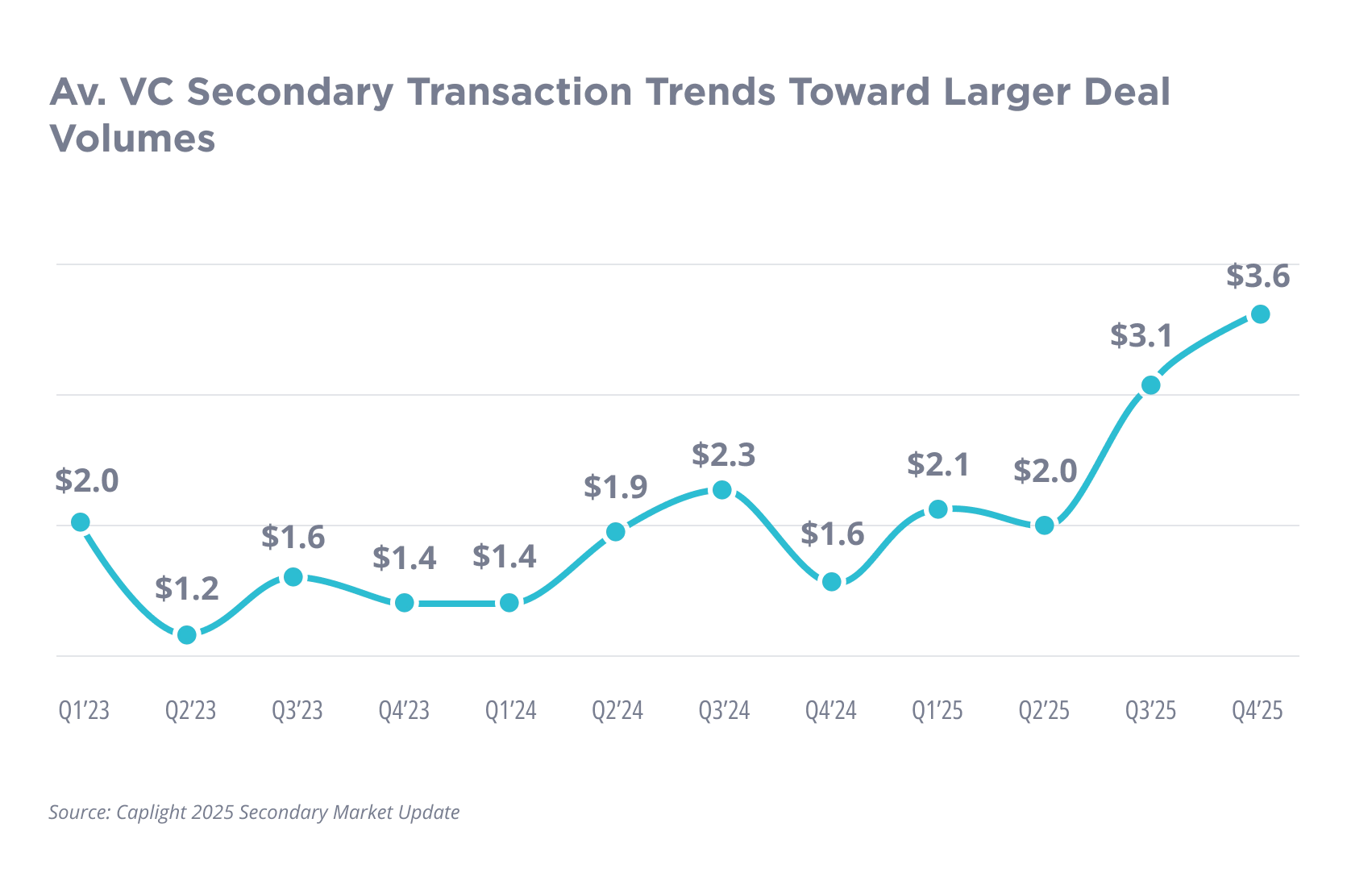
The rise in average secondary transaction size points to a clear shift in shareholder behavior. As valuations recovered in 2025, more holders chose to bring larger blocks to market, using secondaries as a practical way to unlock liquidity without waiting for full exits. This trend reflects renewed confidence in pricing and deeper institutional demand for late stage private assets. Larger deal sizes also signal improved market depth. Buyers are willing to absorb scale, and sellers are increasingly comfortable transacting meaningful positions rather than testing the market with small parcels.
This evolution strengthens the role of secondaries as a core liquidity mechanism in private markets. The Stableton Morningstar PitchBook Unicorn 20 strategy focuses on sourcing and executing larger, institutional grade secondary transactions that align liquidity needs with long term exposure to leading private technology companies.
THE UNTOLD UNICORN STORY
Stripe: From rural Ireland to global payments
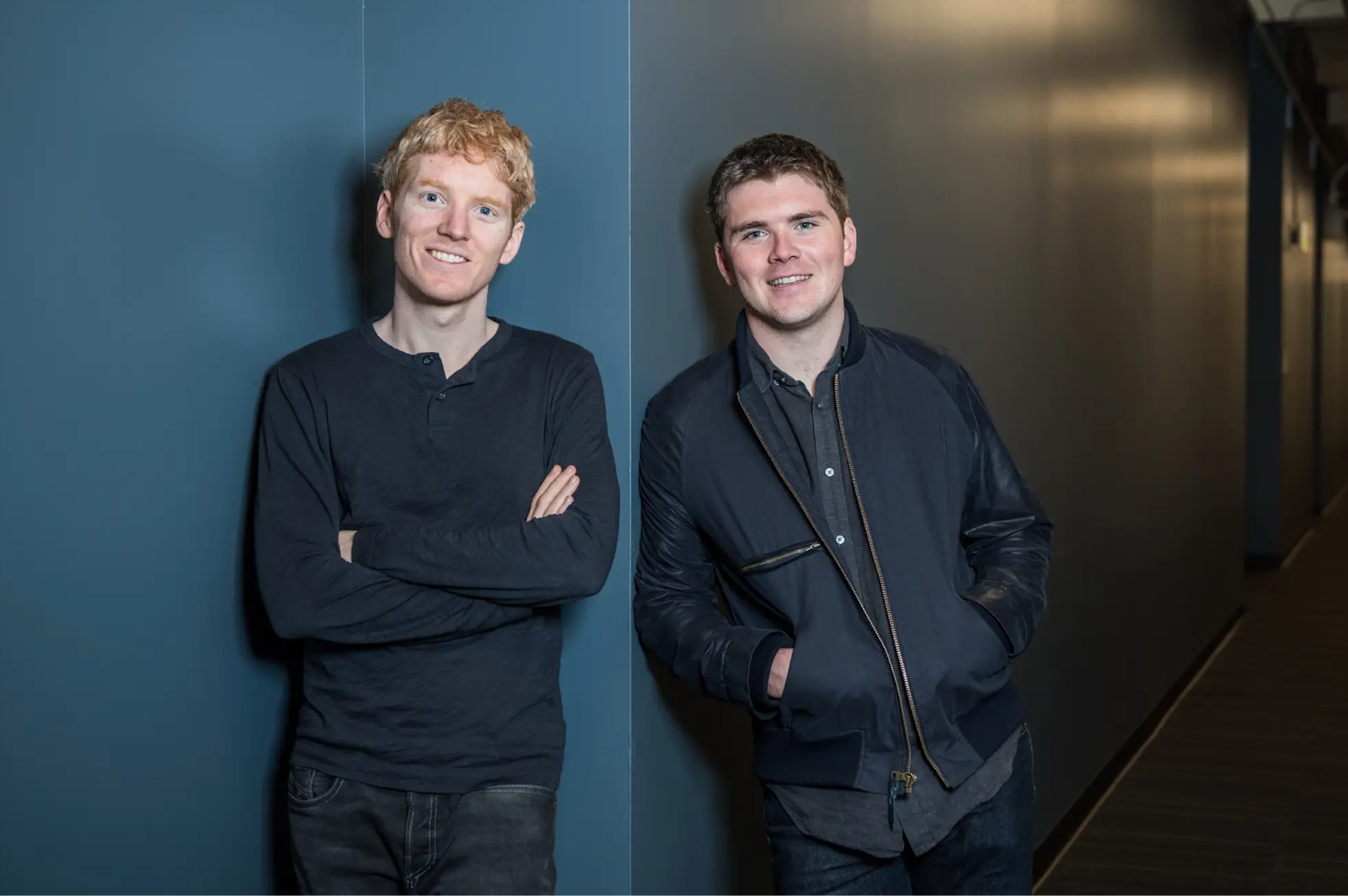 Stripe co-founders, Patrick and John Collison (31)
Stripe exists because two Irish brothers thought accepting payments online was absurdly hard. Patrick and John Collison grew up in Dromineer, a village of fewer than 200 people in rural Ireland, teaching themselves to code without internet access (32). In 2008, at ages 19 and 17, they sold their first company for $5 million, then dropped out of MIT and Harvard to tackle a bigger problem. They built a prototype that let any developer accept payments with just seven lines of code, and launched Stripe in 2011 (33). In 2025, Stripe processed $1.9 trillion in payments, and in February 2026 the company was valued at $159 billion (34).
Fun Fact: In the early days, despite already being millionaires from selling their first company, the Collison brothers biked to the Stripe office every day because they were too frugal to buy a car.
Did you know? Stripe is one of the 20 companies in our Stableton Morningstar PitchBook Unicorn 20 strategy, a systematic, index approach that aims to outperform public benchmarks with low-cost fees, and without a performance fee. Click below for more information.
SOURCES
1 - Financial Times, 2 - Wall Street Journal, 3 - Al Jazeera, 4 - Wired, 5 - Fortune, 6 - LG Corp, 7 - Startup Daily, 8 - Fortune, 9 - CNBC, 10 - Bolsamania, 11 - Databricks, 12 - CNBC, 13 - NBC News, 14 - OpenAI, 15 - Wired, 16 - CNBC, 17 - CNBC, 18 - Korea Times, 19 - Reuters, 20 - Coindesk, 21 - BBC, 22 - Payments Dive, 23 - Gizmodo, 24 - Asia Financial, 25 - SCMP, 26 - Data Center Dynamics, 27 - Financial Times, 28 - TechCrunch, 29 - Wall Street Journal, 30 - TechCrunch, 31 - Business Insider, 32 - Citrus, 33 - TechCrunch, 34 - PYMNTS


Every Wednesday, the Navigator delivers a digest of news from our portfolio holdings and key trends shaping private tech investing. Subscribe to receive it directly in your inbox.



